Quotessence
Home / Quotes / Quote by Caio Fonseca

Quote by Caio Fonseca

“I underwent a whole process of slowly letting go of idiosyncrasies and habits and embellishments and everything extraneous to the essentials that I'm unwilling to let go of. I never dreamed that I would be making black-and-white paintings with so little embellishment. But it's been liberating in many ways to let go of that and yet see what I did want to retain.”

Quote by Caio Fonseca

Author
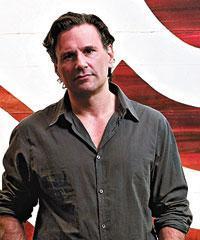
Caio Fonseca
Caio Fonseca

Caio Fonseca, born in 1959, is a renowned Brazilian artist known for his unique style and profound thematic content. His works have gained recognition in the art world for their distinctive visual language and deep social commentary. more

You May Also Like

“One of the most important elements of Caio-ness I wanted to keep was that left to right reading, where one form draws you... this movement in what is otherwise a fairly still art, that sense of pulling the eye. It involves a sense of time. To me that's esoteric and magical and playful, and if a painting doesn't have that, to me it's just canvas and paint. If it does have that, then it rises above its materials.”

“I met Harrison Ford when I was at Comic Con. I didn't know what to say. He was standing behind these two bodyguards - I think he was going up next for Ender's Game - and I had just come off the panel. I saw him sitting over there and I couldn't believe it, so I just walked over to him. He looked right at me and said, "Are you Michael Madsen's son? You look a lot like your dad. You've got a great look, man. I think you're going to have a good future." I just couldn't believe he said that, and then he walked right onto the panel.”

“I've been playing piano my whole life but I'd never tried to understand how compositions are made really. Try to imagine if you'd loved paintings your whole life but had never painted one. My aspiration now is just to understand. I don't have professional pretensions. I've learned so much. So many things I've been doing in the visual, two-dimensional painting world parallel many of the inner working of music - how intervals resolve into each other, harmonic rhythm, tonal things - there's a whole vocabulary that overlaps. Sometimes people see pianos in my works - that I never think.”

“People see so many things in the paintings. Although I never think of them, it charms me a little bit that people actually project actual scenarios on to the paintings. Hopefully that means that they have a little bit of life to them. Figuring out the rhythm, the structural element has been the key thing in this work, more than the color element. It really was the variety of different widths that lead to a certain movement, a rhythm. Otherwise I'd fall into anything that was too stripy or almost like bar codes, and it thwarted the natural flow of the painting.”

“My forms are not abstractions of things in the real world. They're also not symbols. I would say that my job is to invent these forms and to put them together in a way that keeps your interest, to give the forms a quirky identity so you can engage with them, so you realize there's an inner intelligence or logic. If you stop asking what they mean, or what they remind you of, and just look at them for 29 seconds, you find that they want to explain themselves and show you how much every tiniest detail is related to the whole.”

“Everyone accepts the abstraction of Bach. My work aspires to the same kind of abstraction, which is so engaging that you're distracted from asking about what it means. So many paintings have hidden meanings or need wall texts, but my work is not in that category. Once it's in the viewer's eyes my job will be judged on whether or not it is engaging and pulls you in to a kind of intelligence or poetic something going on there that makes it sustainable to look at.”

“For me becoming a painter was an Everest, in terms of what I thought a painter was. There are many roads to becoming an artist. For me it wasn't art school. I didn't have that go to art school and then get a gallery. It's more like, how deep is your inner library to cull from. It's certainly not about technical prowess, just about depth of investigation. It takes time. I had 15 years of painting under my belt before my first New York show. I was glad to have that. It's a good thing to spend your twenties getting your craft.”