Quotessence
Home / Quotes / Quote by E. O. Wilson

Quote by E. O. Wilson

“The second half of the 20th century was a golden age of molecular biology, and it was one of the golden ages of the history of science. Molecular biology was so successful and made such a powerful alliance with the medical scientists that the two together just flourished. And they continue to flourish.”

Quote by E. O. Wilson

Author
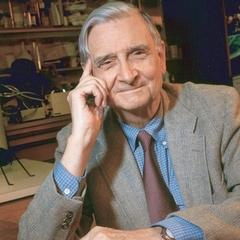
E. O. Wilson
E. O. Wilson

E. O. Wilson is a renowned American biologist, born on June 10, 1929. He has made significant contributions to the fields of entomology, sociobiology, and anthropology. Best known for his research on ants, he is often referred to as the 'father of ants'. His book 'Sociobiology: The New Science' had a profound impact on both biology and the social sciences. more

You May Also Like

“The students of biodiversity, the ones we most need in science today, have an enormous task ahead of molecular biology and the medical scientists. Studying model species is a great idea, but we need to combine that with biodiversity studies and have those properly supported because of the contribution they can make to conservation biology, to agrobiology, to the attainment of a sustainable world.”

“Every ecosystem, even a small one, is sustainable because it has certain ensembles and conditions and influences that are unique to it. And the biological ensembles are almost certainly, even the most modest ones, in the thousands of species. We don't know what's involved in the models - not even the beginnings. And yet we're trying to make a sustainable world, which has to include the natural world. The human species is triumphant, but it's got to get a grip. It's got to come to understand what's happened, why we're this way and what we're doing.”

“If you go from the USA - which, relative to the rest of the world, is in pretty good shape in terms of biodiversity and sustainability - to the tropics, everything gets worse. You have Indonesia, which is destroying its own forest. In West Africa there's no control whatsoever. It's a global situation. For that reason it ties in clearly with the needs and relationships of low-income countries.”

“A paradigm shift is the best a scientist can hope for. Whenever I smell an opportunity like that, I go after it. You have a new discovery that something's working in a different way than you thought. And this is particularly true in molecular and cell biology, which is structural biology and has the least potential for controversy and partisanship among the biological scientists. You're dealing with a concrete object that's either there or not there.”

“Most people are surprised when they hear my somber figures: we know of 2 million species of plants, animals and microorganisms, and we can give them each a scientific name and a diagnostic description. We know, perhaps generously, more than just a little bit of the anatomy in no more than 10 percent. We have done thorough studies in fewer than one-tenth of 1 percent. And the total number of species on Earth is unknown to the nearest order of magnitude.”

“The big question that scientists haven't even begun to get an answer for is how many species of microorganisms are there? Now, this is not stamp collecting. What we need is experts totally devoting their research to everything they can find out about every species, in a community of scientists who appreciate that every fact counts...everything new you learn about any species in any group is worth publishing somewhere.”

“We have to create a sustainable environment, worldwide, and we're not doing it. The best thing we can do with the rest of this century is aggressively acquire - and put aside - the richest natural reserves that we can, and then do our best to manage the needs and desires of the 11 billion people we expect to have by the end of the century. This is where biology is headed. For that reason, the sooner we get on with mapping biodiversity on Earth, the better off biology will be - not to mention the whole subject of saving it before we carelessly throw it away.”