Quotessence
Home / Quotes / Quote by Vladimir Kramnik

Quote by Vladimir Kramnik

“In this respect, I suppose I'm the total opposite of Garry [Kasparov]. With his very emotive body language at the [chess]board he shows and displays all his emotions. I don't.”

Quote by Vladimir Kramnik

Author
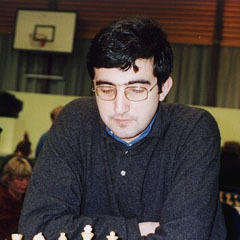
Vladimir Kramnik
Vladimir Kramnik

Vladimir Kramnik, born on June 25, 1975, is a Russian chess grandmaster renowned in the chess world. He has won multiple world chess championships and is considered one of the greatest chess players in history. Kramnik is known for his deep theoretical knowledge and exceptional practical skills. more

You May Also Like

“An immune system of enormous complexity is present in all vertebrate animals. When we place a population of lymphocytes from such an animal in appropriate tissue culture fluid, and when we add an antigen, the lymphocytes will produce specific antibody molecules, in the absense of any nerve cells. I find it astonishing that the immune system embodies a degree of complexity which suggests some more or less superficial though striking analogies with human language, and that this cognitive system has evolved and functions without assistance of the brain.”

“By a generative grammar I mean simply a system of rules that in some explicit and well-defined way assigns structural descriptions to sentences. Obviously, every speaker of a language has mastered and internalized a generative grammar that expresses his knowledge of his language. This is not to say that he is aware of the rules of the grammar or even that he can become aware of them, or that his statements about his intuitive knowledge of the language are necessarily accurate.”

“Hence, a generative grammar must be a system of rules that can iterate to generate an indefinitely large number of structures. This system of rules can be analyzed into the three major components of a generative grammar: the syntactic, phonological, and semantic components... the syntactic component of a grammar must specify, for each sentence, a deep structure that determines its semantic interpretation and a surface structure that determines its phonetic interpretation. The first of these is interpreted by the semantic component; the second, by the phonological component.”