Quotessence
Home / Quotes / Quote by Martin Luther King, Jr.

Quote by Martin Luther King, Jr.

Work

MLK on

This book features a selection of Martin Luther King Jr.'s influential speeches and essays, addressing themes such as civil rights, racial equality, and social justice. It offers insight into the thoughts and beliefs of one of the most prominent figures in the American civil rights movement. more
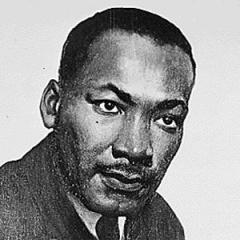
Author

Martin Luther King, Jr.

Martin Luther King Jr. was an American civil rights activist known for his nonviolent protest and advocacy for equal rights. His 'I Have a Dream' speech at the Lincoln Memorial in 1963 became a significant milestone in the American civil rights movement. more

You May Also Like

“Frequently, I go straight into the studio and see what's around. I might hire a couple of instruments that I've never used - maybe a particular type of electronic organ or an echo unit. Then I just dabble with sounds until something starts to happen that suggests a texture. The texture suggests some kind of mood, and the mood suggests some kind of lyric. That's like working in reverse, often quite the other way around, from sound to song. Although often they stop before they get to the song stage.”

“Another way of working is setting deliberate constraints that aren't musical ones - like saying, "Well, this piece is going to be three minutes and nineteen seconds long and it's going to have changes here, here and here, and there's going to be a convolution of events here, and there's going to be a very fast rhythm here with a very slow moving part over the top of it." Those are the sort of visual ideas that I can draw out on graph paper. I've done a lot of film music this way.”

“One way of working is just bring a group of totally different musicians together and encourage them to stick to their guns, not to do the thing that normally happens in a working situation where everyone homogenizes and concedes certain points - so eventually they're all playing in roughly the same style. I wanted quite the opposite of that. I wanted them to accent their styles, so that they pulled away. So there would be a kind of space in the middle where I could operate, and attempt to make these things coalesce in some way. In fact quite a lot of my stuff has arisen from that.”

“If you think of the way a composer or say a pop arranger works - he has an idea and he writes it down, so there's one transmission loss. Then he gives the score to a group of musicians who interpret that, so there's another transmission loss. So he's involved with three information losses. Whereas what I nearly always do is work directly to the sound if it doesn't sound right. So there's a continuous loop going on.”

“You know that in order to copyright material somebody has to write it down for you. Any piece of recorded material has to be scored in order for it to be copyrighted. I've seen the scores of my things and they don't resemble the music in any way. If you give them to somebody who has never heard the music and say, "What does this sound like to you?" they'll play you something that has no relationship with the music it derives from. Notation simply isn't adequate.”