Quotessence
Home / Quotes / Quote by Thomas Hardy

Quote by Thomas Hardy

Work

Far From the Madding Crowd

This novel follows the romantic entanglements of Bathsheba Everdene, a strong-willed woman living in the English countryside, as she navigates love, marriage, and the complexities of her social environment. more

Author
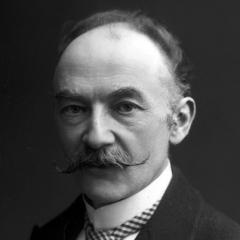
Thomas Hardy
Thomas Hardy

Thomas Hardy, a British novelist born on June 2, 1840, and died on January 11, 1928, is renowned for his novels that depict rural life, reflecting the social changes in 19th-century England. His works often carry a sense of pessimism, depicting the fates of characters with sympathy. more

You May Also Like

“Men thin away to insignificance and oblivion quite as often by not making the most of good spirits when they have them as by lacking good spirits when they are indispensable. Gabriel lately, for the first time since his prostration by misfortune, had been independent in thought and vigorous in action to a marked extent-conditions which, powerless without an opportunity as an opportunity without them is barren, would have given him a sure lift upwards when the favourable conjunction should have occurred. But this incurable loitering beside Bathsheba Everdene stole his time ruinously. The spring tides were going by without floating him off, and the neap might soon come which could not.”

“Heaven opened then, indeed. The flash sprang from east, west, north, south, and was a perfect dance of death. The forms of skeletons appeared in the air, shaped with blue fire for bones-- dancing, leaping, striding, and mingling in unparalleled confusion. With these were intertwined snakes of green, rising and falling, and behind these was a broad mass of lesser light. From every part of the tumbling sky came a shout. ... Gabriel was almost blinded, and he could feel Bathsheba's warm arm tremble in his hand-- a sensation new and thrilling. But love, life, everything human, seemed small and trifling beside the spectacle of an infuriated universe.”

“Because she looks to the sky so often, people think that her life is sweet, that her eyes are dotted with dreamy stars. But quite the opposite is true and I wish they could see— she looks up so much because all around her it's hard to see without breaking her heart. She once saw in a movie a window sign that said "We're all in the gutter; but some of us are looking at the stars." From that movie onwards, she decided to look up! Doesn't mean her life is sweet, doesn't mean her eyes are dotted with dreamy stars.”

“One need not believe in Pallas Athena, the virgin goddess, to be overwhelmed by the Parthenon. Similarly, a man who rejects all dogmas, all theologies and all religious formulations of beliefs may still find Genesis the sublime book par excellence. Experiences and aspirations of which intimations may be found in Plato, Nietzsche, and Spinoza have found their most evocative expression in some sacred books. Since the Renaissance, Shakespeare, Rembrandt, Mozart, and a host of others have shown that this religious dimension can be experienced and communicated apart from any religious context. But that is no reason for closing my heart to Job's cry, or to Jeremiah's, or to the Second Isaiah. I do not read them as mere literature; rather, I read Sophocles and Shakespeare with all my being, too.”