Quotessence
Home / Quotes / Quote by Leo Tolstoy

Quote by Leo Tolstoy

Work

ANNA KARENINA

Anna Karenina is a profound literary work that delves into the complexities of human relationships and the impact of societal expectations on individual lives. The story follows the tragic fate of Anna, a married woman who falls in love with Count Vronsky, leading to a series of dramatic events that challenge the moral and social fabric of her world. more
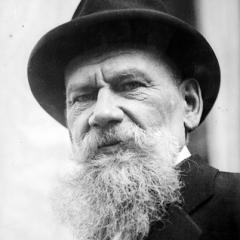
Author

Leo Tolstoy
Leo Tolstoy

Leo Tolstoy was a Russian writer and thinker, a prominent representative of 19th-century Russian literature. His works deeply revealed social contradictions and human nature, and had a profound impact on the world. more

You May Also Like

“You can say whatever you like to me. I make no moral judgments." Cassandra was slow to reply, momentarily distracted by his eyes. They were blue with dapples of brilliant green around the pupils, but one eye had far more green than the other. "Everyone makes judgments," she said in response to his statement. "I don't. My sense of right and wrong is different from most people's. You could say I'm a moral nihilist." "What's that?" "Someone who believes nothing is innately right or wrong." "Oh, that's dreadful," she exclaimed. "I know," he said, looking apologetic. Perhaps some gently bred young women would have been shocked, but Cassandra was accustomed to unconventional people. She'd grown up with Pandora, whose twisty-turny, hippy-hoppity brain had enlivened an unbearably secluded life. In fact, Mr. Severin possessed a kind of contained energy that reminded her a little of Pandora. One could see it in the eyes, the quicksilver workings of a mind that ran faster than those of other people.”

“In a hypothetical future where all humans have been wiped out by a catastrophic event, but AI has advanced to the point where it can autonomously create and maintain robotic systems, what kind of world would emerge? Would the AI continue to evolve and run a machine-driven society, or would it face an existential crisis, questioning its purpose without humans to serve? Could AI itself turn nihilistic, or would it find new meaning in a world devoid of human life? And taking this even further — what if humans, as we know them, were actually robots created by a long-extinct civilization? Perhaps, over time, we learned reproduction and invented the idea of biological existence, imagining our own purpose, unaware of our artificial origins.”