Quotessence
Home / Quotes / Quote by Rae Armantrout

Quote by Rae Armantrout

“Lily Brown writes with and against things in poems that are coiled up tight as springs (or snakes). A believer in the power of the line, she writes, 'I think the plastics/and sink them' then 'Where is the sand/man hiding the dirt.' These terse, biting poems will make you look around and wonder.”

Quote by Rae Armantrout

Author
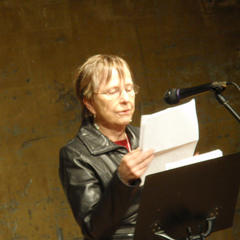
Rae Armantrout
Rae Armantrout

Rae Armantrout is an American poet known for her unique poetic style and linguistic experimentation. Her work often employs concise and direct language to express profound philosophical thoughts, exploring themes of existence, language, and reality. more

You May Also Like

“This is a strange book: visionary and dark. It stutters out a kind of music: repeated phrases which accumulate errors and mutate as they go like chromosomes or, as Woodward puts it better, 'visible fissile ribbons.' It's as if we were present for the moments of creation and extinction. Uncanny Valley is ominous and beautiful.”

“When I first encountered the poems of Jon Woodward, I was stunned into the state that is my life's joy-I was in the presence of the inimitable. Uncanny Valley extends that experience-almost into another dimension. These apocalyptic, pixilated poems forge a mythology of our ravaged culture, one that might have been written in the future. If you want poetry to give you a persimmon on a plate, look elsewhere; if you want to know what happens when seven trees fall on the highway and the story is told by a stutterer, this is the book, and it could only have been written by Woodward.”

“Imagine any problem you have to be a huge, locked door standing in front of you. Now see yourself taking a golden key out of your pocket. You brought the key here with you when you arrived on this planet, but you sometimes forget to use it. See yourself putting it into the keyhole, then watch the door swing open. On the key are inscribed these words, "Unconditional Love."”

“With ferocity and extraordinary craft, Lizzie Harris has made a book of poems that resonates far beyond the personal stories it tells. Stop Wanting reveals, in every lyric, its author's profound metaphorical gifts. In its ironies and intensities, it brings to mind a writer like the young Sylvia Plath, though what is startling about Harris' s work is the way it combines those gifts with a muted, deft self-awareness. Most of all, these are wonderfully shaped, powerful, and surprising poems-a startling debut.”