Quotessence
Home / Quotes / Quote by Pierre-Simon Laplace

Quote by Pierre-Simon Laplace

“However, the small probability of a similar encounter [of the earth with a comet], can become very great in adding up over a huge sequence of centuries. It is easy to picture to oneself the effects of this impact upon the Earth. The axis and the motion of rotation changed; the seas abandoning their old position to throw themselves toward the new equator; a large part of men and animals drowned in this universal deluge, or destroyed by the violent tremor imparted to the terrestrial globe.”

Quote by Pierre-Simon Laplace

Author
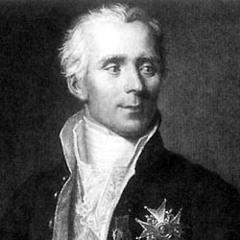
Pierre-Simon Laplace

Pierre-Simon Laplace was a renowned French mathematician and astronomer born on March 23, 1749, and died on March 5, 1827. He is considered one of the founders of probability theory and celestial mechanics. Laplace's work in mathematics, astronomy, and probability has had a profound impact on the development of modern science. more

You May Also Like

“If we imagine an observer to approach our planet from outer space, and, pushing aside the belts of red-brown clouds which obscure our atmosphere, to gaze for a whole day on the surface of the earth as it rotates beneath him, the feature, beyond all others most likely to arrest his attention would be the wedge-like outlines of the continents as they narrow away to the South.”

“In the course of the history of the earth innumerable events have occurred one after another, causing changes of states, all with certain lasting consequences. This is the basis of our developmental law, which, in a nutshell, claims that the diversity of phenomena is a necessary consequence of the accumulation of the results of all individual occurrences happening one after another... The current state of the earth, thus, constitutes the as yet most diverse final result, which of course represents not a real but only a momentary end-point.”

“In the course of this short tour, I became convinced that we must turn to the New World if we wish to see in perfection the oldest monuments of the earth's history, so far at least as relates to its earliest inhabitants.”

“In the first book I shall describe all the positions of the spheres, along with the motions which I attribute to the Earth, so that the book will contain as it were the general structure of the universe. In the remaining books I relate the motions of the remaining stars, and all the spheres, to the mobility of the Earth, so that it can be thence established how far the motions and appearances of the remaining stars and spheres can be saved, if they are referred to the motions of the Earth.”

“It is in the nature of water ... to become transformed into earth through a predominating earthy virtue; ... it is in the nature of earth to become transformed into water through a predominating aqueous virtue.”

“It must not be thought that it is ever possible to reach the interior earth by any perseverance in mining: both because the exterior earth is too thick, in comparison with human strength; and especially because of the intermediate waters, which would gush forth with greater impetus, the deeper the place in which their veins were first opened; and which would drown all miners.”

“Since, then, there is no objection to the mobility of the Earth, I think it must now be considered whether several motions are appropriate for it, so that it can be regarded as one of the wandering stars. For the fact that it is not the centre of all revolutions is made clear by the apparent irregular motion of the wandering stars, and their variable distances from the Earth, which cannot be understood in a circle having the same centre as the Earth.”