Quotessence
Home / Quotes / Quote by Pope Leo XIII

Quote by Pope Leo XIII

“Our Lord came to the aid of each great tribulation with a special devotion. The present and future tribulations of the Church and of nations are greater than at any other period, and this persecution is more dangerous than those of previous times. Hence, the devotion which God sends to the succor of His Church and of the nations at the present time is the devotion to the Most Holy Eucharist. It is the highest of all devotions.”

Quote by Pope Leo XIII

Author
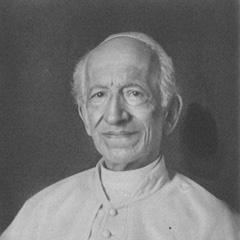
Pope Leo XIII
Pope Leo XIII

Pope Leo XIII (born Vincenzo Gioacchino Raffaele Luigi Pecci) served as the 256th Pope of the Catholic Church from 1878 to 1903, making him one of the longest-reigning popes in history. Born on March 2, 1810, in Carpineto, Italy, he died on July 20, 1903, in Rome. He is renowned for establishing modern Catholic social teaching through his landmark encyclical Rerum Novarum (1891), which addressed workers' rights and became a foundation of Catholic social doctrine. Leo XIII promoted Thomistic philosophy and worked to reconcile the Catholic Church with the modern world. more

You May Also Like

“Know also that you will probably gain more by praying fifteen minutes before the Blessed Sacrament than by all the other spiritual exercises of the day. True, Our Lord hears our prayers anywhere, for He has made the promise, 'Ask, and you shall receive,' but He has revealed to His servants that those who visit Him in the Blessed Sacrament will obtain a more abundant measure of grace.”

“The Eucharist is source and pledge of blessedness and glory, not for the soul alone, but for the body also.... In the frail and perishable body that divine Host, which is the immortal body of Christ, implants a principle of resurrection, a seed of immortality, which one day must germinate”

“Our hours of adoration will be special hours of reparation for sins, and intercession for the needs of the whole world, exposing the sin-sick and suffering humanity to the healing, sustaining and transforming rays of Jesus, radiating from the Eucharist.”

“This practice of adoration is based on strong and solid reasons. For the Eucharist is at once a sacrifice and a sacrament; but it differs from the other sacraments in that it not only produces grace, but contains in a permanent manner the Author of Grace Himself. When, therefore, the Church bids us to adore Christ hidden behind the Eucharistic veils and to pray to Him for spiritual and temporal favors, of which we ever stand in need, she manifests faith in her divine Spouse who is present beneath these veils, she professes her gratitude to Him, and she enjoys the intimacy of His friendship”