Quotessence
Home / Quotes / Quote by Arthur C. Clarke

Quote by Arthur C. Clarke

Work

Report on Planet Three

This book offers a comprehensive account of an expedition to an unknown planet, known as Planet Three. It includes extensive observations of the planet's landscape, flora, fauna, and the scientific analysis conducted by the explorers. The narrative delves into the challenges faced during the mission and the significance of the findings for both science and humanity. more

Author
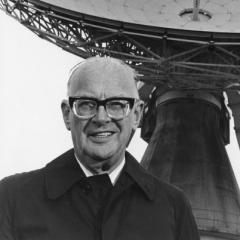
Arthur C. Clarke
Arthur C. Clarke

Arthur C. Clarke was a British science fiction author, writer, and science popularizer. Known for his science fiction novels and predictions about future technology, his most famous works include '2001: A Space Odyssey' and 'Rendezvous with Rama'. Clarke's science fiction novels are not only literarily valuable but also had a profound impact on science fiction films and television. more

You May Also Like

“I never said it. Honest. Oh, I said there are maybe 100 billion galaxies and 10 billion trillion stars. It's hard to talk about the Cosmos without using big numbers. I said "billion" many times on the Cosmos television series, which was seen by a great many people. But I never said "billions and billions." For one thing, it's too imprecise. How many billions are "billions and billions"? A few billion? Twenty billion? A hundred billion? "Billions and billions" is pretty vague. When we reconfigured and updated the series, I checked-and sure enough, I never said it.”

“They have likewise discovered two lesser stars, or satellites, which revolve around Mars, whereof the innermost is distant from the center of the primary exactly three of his diameters, and the outermost five: the former revolves in the space of ten hours, and the latter in twenty-one and a half, so that the squares of their periodical times are very near in the same proportion with the cubes of their distances from the center of Mars; which evidently shows them to be governed by the same Law of Gravitation that influences the other heavenly bodies.”

“From the moment they had left the Earth, their own weight, and that of the Projectile and the objects therein contained, had been undergoing a progressive diminution. . . . Of course, it is quite clear, that this decrease could not be indicated by an ordinary scales, as the weight to balance the object would have lost precisely as much as the object itself. But a spring balance, for instance, in which the tension of the coil is independent of attraction, would have readily given the exact equivalent of the loss.”

“The distance between the earth and her satellite is a mere trifle, and undeserving of serious consideration. I am convinced that before twenty years are over one-half of our earth will have paid a visit to the moon.”