Quotessence
Home / Quotes / Quote by Ayaan Hirsi Ali

Quote by Ayaan Hirsi Ali

Work

Prey: Immigration, Islam, and the Erosion of Women's Rights

Browse quotes and source details for this work. more

Author
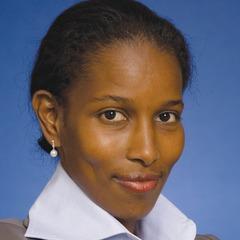
Ayaan Hirsi Ali
Ayaan Hirsi Ali

Ayaan Hirsi Ali is an influential writer, politician, and activist known for her advocacy on women's rights, religious freedom, and anti-terrorism. Born in Somalia, she grew up in the Netherlands and gained widespread attention for her criticism of Islam and women's rights. more

You May Also Like

“men monopolizes the most desirable mates. Since accumulating wealth and status takes time and work for most men, the norm of polygamy pushes up the age of marriage for males, drives down the age of marriage for females, removes incentives for female educational and economic attainment, and increases the fertility rate. The surplus of unmarried males scrambling for an artificially reduced pool of marriageable females spurs the growth of crime and violence.”

“Rapists are created, not born” has become the accepted wisdom.39 But when it comes to migrants and minorities, pointing to cultural explanations for their behavior toward women is taboo. This seems contradictory. Indeed, when you consider how Muslim men are educated about sex—or not—it makes no sense at all.”

“Dawa is happening not only in Muslim communities but also in Western prisons. Believing that religious education will benefit prisoners, the authorities mistakenly give agents of dawa access to Muslim prisoners. Like wolves in sheep’s clothing, they claim to be religious community representatives, all the while harboring links to terrorist organizations such as the Muslim Brotherhood, ISIS, and Hizb ut-Tahrir.”

“Honor violence is a set of enforcement measures used to uphold the modesty doctrine. Girls and women who step out of line face injury and even murder at the hands of relatives if they drift too far toward emancipation. So-called honor killing is meant to remove a stain on a family’s honor caused by real or alleged sexual misconduct. In Western countries, the victims of honor violence also include Sikh, Hindu, and Kurdish women, but most appear to be Muslim.”

“Young people in Western societies have grown up with the assumption that gender equality is a given. They did not have to fight for basic equality and are often oblivious to its being undermined around them. Even when they are confronted with the erosion of women’s rights in the street, they sometimes apologize for criticizing their attackers. In court, victims of sexual assault appearing on the witness stand have to insist that they are not racists. Almost every woman I interviewed in the course of researching this book felt obliged to begin with a caveat: “I’m not against migrants,” “I’m from the Left,” or “I am not racist.”

“La séparation d'avec nos camarades masculins ne s'est pas faite sans douleur. Il nous semblait qu'ils auraient dû se réjouir que nous élargissions par notre lutte le front anticapitaliste, mais pourtant nous n'avons pas trouvé beaucoup de soutien de leur part [...] Nous avons aussi souffert d'un manque de reconnaissance, puisque nos modes d'action n'étaient pas du même ordre que les leurs, ils ne les voyaient pas, et disaient que "nous ne faisions rien". De même qu'ils n'avaient pas vu notre travail domestique, ils ne voyaient pas notre travail politique autonome [...] De plus, les femmes "en mouvement" changeaient et les rapports, y compris personnels, se brisaient.”

“Communication with heterosexual women is fraught with difficulties, with static which comes from their relationships with men. Men distort such communication. A heterosexual woman will have a different perception and reaction to things you say; she may be defensive and is likely to be thinking, 'What about Nigel?' When you talk of women's interests and the future and survival of women, her imagination may be blocked by concern for her man and his brothers. You feel under pressure to say nice things which will not threaten her.”