Quotessence
Home / Quotes / Quote by Billy Graham

Quote by Billy Graham

Work

Billy Graham in Quotes

This book presents a collection of insightful and thought-provoking quotes from the speeches, sermons, and writings of Billy Graham, offering a glimpse into his spiritual wisdom and influential perspective on faith and life. more

Author
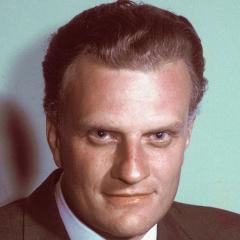
Billy Graham
Billy Graham

Billy Graham (born November 7, 1918) was a prominent American evangelist, widely regarded as one of the most influential Christian leaders of the 20th century. Graham, born in a farming family in North Carolina, developed a deep passion for religion from an early age. He began his ministry in 1939 and spent the following decades spreading the Christian Gospel through radio, television, books, and speaking engagements to hundreds of millions of people around the world. more

You May Also Like

“Reality is that which exists; the unreal does not exist; the unreal is merely that negation of existence which is the content of a human consciousness when it attempts to abandon reason. Truth is the recognition of reality; reason, man’s only means of knowledge, is his only standard of truth.”

“Yes, this is an age of moral crisis. Yes, you are bearing punishment for your evil. But it is not man who is now on trial and it is not human nature that will take the blame. It is your moral code that’s through, this time. Your moral code has reached its climax, the blind alley at the end of its course. And if you wish to go on living, what you now need is not to return to morality—you who have never known any—but to discover it.”

“Man cannot survive except by gaining knowledge, and reason is his only means to gain it. Reason is the faculty that perceives, identifies and integrates the material provided by his senses. The task of his senses is to give him the evidence of existence, but the task of identifying it belongs to his reason, his senses tell him only that something is, but what it is must be learned by his mind.”

“Parlando di morale, Camus fa ridere quei cinici che, dopo aver letto Lenin, Trotskij e Stalin, primeggiavano per sofismi. Leon Trotskij, che ha creato l'Armata Rossa, che ha massacrato i marinai libertari di Kronstadt, scrive La loro morale e la nostra. Si tratta di un capolavoro per i dittatori di ieri, di oggi e di domani. Distinguendo tra morale borghese e morale rivoluzionaria impedisce di giudicare la rivoluzione con le categorie della morale borghese ed esige un giudizio secondo i criteri della morale rivoluzionaria. È così che fucilare, torturare, mandare al gulag sono azioni cattive per il borghese, ma per il rivoluzionario sono buone, perché, presentate come inezie dialettiche, pur nella loro negatività, sono chiamate a produrre il positivo avvento della rivoluzione proletaria, perlomeno per quei pochi che saranno sopravvissuti. La logica consequenziale e opportunista di questa morale rivoluzionaria priva di principi, stava bene tanto a Hitler, Lenin, Mussolini che a Stalin, Pétain, Trotskij, Franco e Mao, e stava bene persino a Sartre. Ma non è mai andata bene a Camus.”

“When a political opponent resorts to the racist card, it's a sure sign of moral bankruptcy: there's no decent argument left in the armoury.”

“The purpose of college, to put this all another way, is to turn adolescents into adults. You needn't go to school for that, but if you're going to be there anyway, then that's the most important thing to get accomplished. That is the true education: accept no substitutes. The idea that we should take the first four years of young adulthood and devote them to career preparation alone, neglecting every other part of life, is nothing short of an obscenity. If that's what people had you do, then you were robbed. And if you find yourself to be the same person at the end of college as you were at the beginning - the same beliefs, the same values, the same desires, the same goals for the same reasons - then you did it wrong. Go back and do it again.”