Quotessence
Home / Quotes / Quote by Albert Einstein

Quote by Albert Einstein

“e idea of a personal God is quite alien to me and seems even naive. However, I am also not a "Freethinker" in the usual sense of the word because I find that this is in the main an attitude nourished exclusively by an opposition against naive superstition. My feeling is insofar religious as I am imbued with the consciousness of the insuffiency of the human mind to understand deeply the harmony of the Universe which we try to formulate as "laws of nature." It is this consciousness and humility I miss in the Freethinker mentality. Sincerely yours, Albert Einstein.”

Quote by Albert Einstein

Author
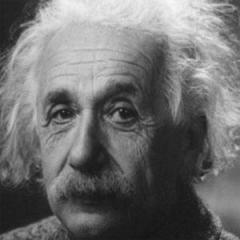
Albert Einstein
Albert Einstein

Albert Einstein, a German-born theoretical physicist, is renowned for his work on relativity and the photoelectric effect. His contributions revolutionized our understanding of the universe and had a profound impact on modern physics. more

You May Also Like

“The essence of any religion lies solely in the answer to the question: why do I exist, and what is my relationship to the infinite universe that surrounds me? It is impossible for there to be a person with no religion (i.e. without any kind of relationship to the world) as it is for there to be a person without a heart. He may not know that he has a religion, just as a person may not know that he has a heart, but it is no more possible for a person to exist without a religion than without a heart.”

“When it was first said that the sun stood still and world turned round, the common sense of mankind declared the doctrine false; but the old saying of Vox populi, vox Dei [the voice of the people is the voice of God], as every philosopher knows, cannot be trusted in science.”

“How so many absurd rules of conduct, as well as so many absurd religious beliefs, have originated, we do not know; nor how it is that they have become, in all quarters of the world, so deeply impressed on the minds of men; but it is worthy of remark that a belief constantly inculcated during the early years of life, while the brain is impressionable, appears to acquire almost the nature of an instinct; and the very essence of an instinct is that it is followed independently of reason.”

“I am aware that the assumed instinctive belief in God has been used by many persons as an argument for his existence. The idea of a universal and beneficent Creator does not seem to arise in the mind of man, until he has been elevated by long-continued culture.”

“But I own that I cannot see as plainly as others do, and I should wish to do, evidence of design and beneficence on all sides of us. There seems to me too much misery in the world. I cannot persuade myself that a beneficent and omnipotent God would have designedly created that a cat should play with mice.”