Quotessence
Home / Quotes / Quote by David Rockefeller

Quote by David Rockefeller

Author

David Rockefeller
David Rockefeller

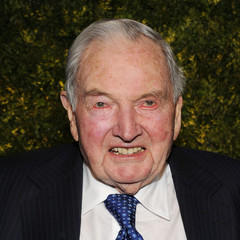
David Rockefeller was an American banker and philanthropist. He served as the chairman and chief executive officer of Chase Manhattan Bank and as the U.S. ambassador to the United Nations. As a member of the influential Rockefeller family, he played a significant role in American business and politics during the 20th century. more

You May Also Like

“I don't recall that I have said and I don't think that I really feel that we need a world government. We need governments of the world that work together and collaborate. But, I can't imagine that there would be any likelihood or even that it would be desirable to have a single government elected by the people of the world.”

“Although the problem of transmuting chemical elements into each other is much older than a satisfactory definition of the very concept of chemical element, it is well known that the first and most important step towards its solution was made only nineteen years ago by the late Lord Rutherford, who started the method of the nuclear bombardments.”

“To be at one with God is to be at peace. The child simplicity is the greatest agency in bringing this full and complete realization, the child simplicity that recognizes its true relations with the Father's life. There are people I know who have come into such a conscious realization of their oneness with this Infinite Life, this Spirit of Infinite Peace, that their lives are fairly bubbling over with joy.”

“The Orient that appears in Orientalism, then, is a system of representations framed by a whole set of forces that brought the Orient into Western learning, Western consciousness, and later, Western empire.... The Orient is the stage on which the whole East is confined. On this stage will appear the figures whose role it is to represent the larger whole from which they emenate. The Orient then seems to be, not an unlimited extension beyond the familiar European world, but rather a closed field, a theatrical stage affixed to Europe.”

“The central fact for me is, I think, that the [role of the] intellectual... cannot be played without a sense of being someone whose place it is publicly to raise embarrassing questions, to confront orthodoxy and dogma (rather than to produce them), to be someone who cannot easily be co-opted by governments or corporations, and whose raison d'etre is to represent all those people and issues that are routinely forgotten or swept under the rug.”