Quotessence
Home / Quotes / Quote by Swami Vivekananda

Quote by Swami Vivekananda

“Never say, "O Lord, I am a miserable sinner." Who will help you? You are the help of the universe. What in this universe can help you? What can prevail over you? You are the God of the universe; where can you seek for help? Never help came from anywhere but from yourself. In your ignorance, every prayer that you made and that was answered, you thought was answered by some Being, but you answered the prayer yourself unknowingly. The help came from yourself, and you fondly imagined that someone was sending help to you. There is no help for you outside of yourself; you are the creator of the universe. Like the silkworm, you have built a cocoon around yourself. Who will save you? Burst your own cocoon and come out as a beautiful butterfly, as the free soul. Then alone you will see Truth.”

Quote by Swami Vivekananda

Work

The Complete Works of Swami Vivekananda, Volume 3

Browse quotes and source details for this work. more

Author
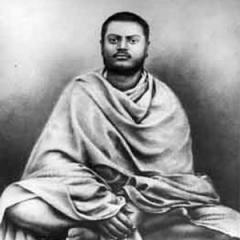
Swami Vivekananda
Swami Vivekananda

Swami Vivekananda (January 12, 1863 – July 4, 1902) was an Indian Hindu monk, philosopher, and social reformer. Born as Narendranath Datta in Kolkata, he was a chief disciple of the mystic Ramakrishna. He is best known for his historic speech at the 1893 Parliament of the World's Religions in Chicago, where he introduced Hinduism to the Western world. He founded the Ramakrishna Mission in 1897, focusing on social service, education, and interfaith harmony. His teachings emphasized self-realization, service to humanity, and the unity of all religions. He wrote extensively on yoga and Vedanta philosophy, influencing global spirituality and Indian nationalism. He died at the age of 39, leaving a lasting legacy as a bridge between Eastern and Western thought. more

You May Also Like

“The man who had the best stock of health and the most faith and pluck, was the most wealthy, for we were all capitalists in those days. Each one expected to help himself, and as a rule all went to work with energy to open up the country and make homes for themselves, and at the same time they were ever ready to help each other in case of need or misfortune, and I will presume to say that if the people now possessed more of the spirit that then actuated the “old moss backs,” as some reproachfully style the old settlers, we would hear less about a conflict between labor and capital, which in truth is largely a conflict between labor and laziness. We had no eight hour, nor even ten hour days then, and I never heard of any one striking, not even an Indian”

“When you bring your best to the table, no matter where you are or what you are doing, you bring out the best in others. And soon, you start to realize, that, in turn, helps them bring out the best in you. That’s the upward spiral. You find each other and form an elite group of go-to people in an otherwise ordinary context. I see that happen everywhere I go: circles or networks of go-to people who help each other and go out of their way to be mutually reliable.”

“I know this is your religion, but for me it’s just a job.” “That’s your problem,” Basil said. “For you it’s ‘just’ a job.” “What’s it supposed to be?” “Work.” “Same thing,” Amy said. “No,” Basil said. “A job is what a guy in a gas station has. People at Orsk have work. It’s a calling. A responsibility to something bigger than yourself. Work gives you a goal. It lets you build something that lives on after you’re gone. Work has a purpose beyond making money.” “I am begging you to stop,” Amy said. “There’s nothing wrong with being serious,” Ruth Anne said. “She can’t take anything seriously,” Basil said. “That’s her problem.” “I do my job,” Amy said. “I punch the clock, I work my shop, I sell people their desks, I cash my check. That’s what Orsk pays me to do: my job. I’m not planning on being in retail for the rest of my life.” “Really? What are you going to do?” “I’m …” Amy suddenly realized that in fact she didn’t have any plans. “I’ve got plans. They’re none of your business.”