Quotessence
Home / Quotes / Quote by Guy de Maupassant

Quote by Guy de Maupassant

“This notary was a little man, completely round, round in every part. His head looked like a ball nailed onto another ball, supported by two legs that were so tiny and so short that they also closely resembled balls.”
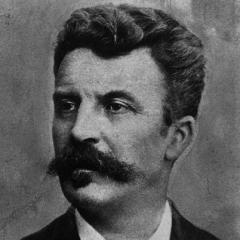
Quote by Guy de Maupassant

Book:Bel-Ami

Work

Bel-Ami

Georges Duroy, a young and ambitious man, navigates the Parisian high society of the 1860s, using his charm and cunning to rise to the top. The story delves into the complexities of human nature and the corrupting influence of power and wealth. more

Author

Guy de Maupassant
Guy de Maupassant

Guy de Maupassant, born on August 5, 1850 and died on July 6, 1893, was a renowned French novelist and master of the short story, often hailed as the 'King of Short Stories'. With his keen observation and unique writing style, Maupassant produced a vast array of short stories reflecting social realities and human weaknesses, which have had a profound impact on literature. more

You May Also Like

“‎...minun mielestäni nykyinen teatteri vain pelkkää rutiinia, ennakkoluuloa. Kun esirippu nousee ja nuo suuret kyvyt, pyhän taiteen papit ja papittaret, esittävät kolmiseinäisessä huoneessa iltavalaistuksessa miten ihmiset syövät, juovat, rakastavat, kävelevät, miten kantavat pukuaan, kun he halpahintaisista kuvaelmista ja korulauseista koettavat onkia esiin moraalia — pientä, helppotajuista, kotioloissa tarvittavaa moraalia, kun minulle tuhansien eri muunnosten muodossa tarjotaan aina vain yhtä ja samaa, yhtä ja samaa, yhtä ja samaa — niin minä juoksen pakoon, juoksen pakoon kuin Maupassant Eiffel-tornia, joka pusersi hänen aivojaan lattaudellaan.”

“He did not know how to make her understand that he would be happy, most happy, to become her husband in his turn. He certainly could not tell her that, now, at this moment, in this place, in the presence of this corpse; nevertheless he could, he believed, find one of those ambiguous, acceptable, complicated statements whose words have hidden significance, and which can, by their calculated reservations, express everything you intend.”

“The great self-limitation practiced by man for ten centuries yielded, between the fourteenth and seventeenth centuries, the whole flower of the so-called "Renaissance." The root, usually, does not resemble the fruit in appearance, but there is an undeniable connection between the root's strength and juiciness and the beauty and taste of the fruit. The Middle Ages, it seems, have nothing in common with the Renaissance and are opposite to it in every way; nonetheless, all the abundance and ebullience of human energies during the Renaissance were based not at all on the supposedly "renascent" classical world, nor on the imitated Plato and Virgil, nor on manuscripts torn from the basements of old monasteries, but precisely on those monasteries, on those stern Franciscians and cruel Dominicans, on Saints Bonaventure, Anselm of Canterbury, and Bernard of Clairvaux. The Middle Ages were a great repository of human energies: in the medieval man's asceticism, self-abnegation, and contempt for his own beauty, his own energies, and his own mind, these energies, this heart, and this mind were stored up until the right time. The Renaissance was the epoch of the discovery of this trove: the thin layer of soil covering it was suddenly thrown aside, and to the amazement of following centuries dazzling, incalculable treasures glittered there; yesterday's pauper and wretched beggar, who only knew how to stand on crossroads and bellow psalms in an inharmonious voice, suddenly started to bloom with poetry, strength, beauty, and intelligence. Whence came all this? From the ancient world, which had exhausted its vital powers? From moldy parchments? But did Plato really write his dialogues with the same keen enjoyment with which Marsilio Ficino annotated them? And did the Romans, when reading the Greeks, really experience the same emotions as Petrarch, when, for ignorance of Greek, he could only move his precious manuscripts from place to place, kiss them now and then, and gaze sadly at their incomprehensible text? All these manuscripts, in convenient and accurate editions, lie before us too: why don't they lead us to a "renascence" among us? Why didn't the Greeks bring about a "renascence" in Rome? And why didn't Greco-Roman literature produce anything similar to the Italian Renaissance in Gaul and Africa from the second to the fourth century? The secret of the Renaissance of the fourteenth-fifteenth centuries does not lie in ancient literature: this literature was only the spade that threw the soil off the treasures buried underneath; the secret lies in the treasures themselves; in the fact that between the fourth and fourteenth centuries, under the influence of the strict ascetic ideal of mortifying the flesh and restraining the impulses of his spirit, man only stored up his energies and expended nothing. During this great thousand-year silence his soul matured for The Divine Comedy; during this forced closing of eyes to the world - an interesting, albeit sinful world-Galileo was maturing, Copernicus, and the school of careful experimentation founded by Bacon; during the struggle with the Moors the talents of Velasquez and Murillo were forged; and in the prayers of the thousand years leading up to the sixteenth century the Madonna images of that century were drawn, images to which we are able to pray but which no one is able to imitate. ("On Symbolists And Decadents")”

“Now the final dogmatic veil has been eternally torn away, the final mystical spirit is being extinguished. And here stand today's people, defenseless-face to face with the indescribable gloom, on the dividing line of light and darkness, and now no one can protect his heart any longer from the terrifying cold drifting up out of the abyss. Wherever we might go, wherever we might hide behind the barrier of scientific criticism, we feel with all our being the nearness of a mystery, the nearness of the ocean. There are no limits! We are free and lonely... No enslaved mysticism of a previous age can be compared with this terror. Never before have people felt in their hearts such a need to believe, and in their minds comprehended their inability to believe. In this diseased and irresolvable dissonance, in this tragic contradiction, as well as in the unheard-of intellectual freedom, in the courage of negation, is contained the most characteristic feature of the mystical need of the nineteenth century. Our time must define in two contrasting features this time of the most extreme materialism and at the same time of the most passionate idealistic outbursts of the spirit. We are witnessing a mighty and all-important struggle between two views of life, between two diametrically opposed worldviews. The final demands of religious feeling are experiencing a confrontation with the final conclusions of the experimental sciences. The intellectual struggle which filled the nineteenth century could not but be reflected in contemporary literature. ("On The Reasons For The Decline And On The New Tendencies In Contemporary Literature")”

“From the fourteenth to the nineteenth century we have merely been expending the incalculable treasures discovered then and using up the great supply of energies gathered up to that time. Hence, modern history is the antithesis of the Middle Ages; man no longer wants to keep silent about himself: he hastens to express to others every slightest feeling and every new thought he may have through the medium of colors or sounds and, without fail, by means of the printing press. One might say that just as man studiously effaced himself up to the fourteenth century, so he becomes garrulous once he crosses into that century and all the succeeding ones. Not only what is wise, not only what is noble, but also what is ridiculous, stupid, and hideous in himself he couches in poetry and prose, sets to music, and would very much like, but he is unable, to express in marble and to fix within architectural lines. It is remarkable that architecture - that kind of impersonal art, that form of creation in which the creator is merged with his epoch and people, in which he does not rise above them, nor set apart his own I on their background - declines, as soon as we enter modern history, and not once during this period does it rise to the sublime or the beautiful. ("On Symbolists And Decadents")”

“In essence the entire generation at the end of the nineteenth century bears in its soul that same reaction against the suffocatingly dead positivism which lay on hearts like a stone. It is quite possible that they will perish, that they will not succeed in accomplishing anything. But others will come and will carry on, all the same, their work, because this work is vital... Symbols must naturally and effortlessly emerge out of the depth of reality. But if the author unnaturally invents them in order to express some idea or other, they will be transformed into dead allegories which arouse nothing other than repulsion like all that is dead. ("On The Reasons For The Decline And On The New Tendencies In Contemporary Literature")”

“Before us is mighty, so to speak, transformative and preparatory work. From a period which is creative, immediate and elemental, we must proceed to a period which is critical, conscious and cultural. These are the two worlds between which exists the entire abyss. The contemporary generation has the misfortune of being born between these two worlds, before this abyss. Herein is explained its frailty, diseased anxiety, hungry search for new ideals and a certain fateful impotency in all of its efforts. The best youth and vigor of talent is not expended on vital creativity but on an internal destructiveness and struggle with the past, on the passage across the abyss to that land, to that shore, to the frontiers of a free and divine idealism. How many people are perishing in this passage or are losing their strength irrevocably!... ("On The Reasons For The Decline And On The New Tendencies In Contemporary Literature")”