Quotessence
Home / Quotes / Quote by Francis of Assisi

Quote by Francis of Assisi

“Dear God, please reveal to us your sublime beauty, that is everywhere, everywhere, everywhere, so that we will never again feel frightened.”

Quote by Francis of Assisi

Author
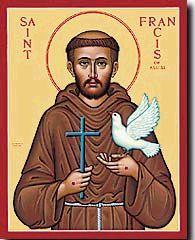
Francis of Assisi
Francis of Assisi

St. Francis of Assisi was an Italian Catholic saint who lived from June 24, 1182, to October 3, 1226. He is considered a reformer of the Catholic Church, known for his emphasis on poverty and simplicity of life. more

You May Also Like

“Our nature is to worship, but unless that element is directed towards God it becomes "a senseless impersonal force, carrying us away in its momentum. It becomes a search for ecstasy - no matter what kind achieved through destruction...The worshipful integraton of nature in the person is inverted in a hellish imprisonment of the individual in nature."”

“Then Christ will say to us, 'Come you also! Come you drunkards! Come you weaklings! Come you depraved!' And he will say to us, 'Vile creatures, you in the image of the beast and you who bear his mark. All the same, you come too!' And the wise and prudent will say, 'Lord, why are you welcoming them? And he will say, 'O wise and prudent, I am welcoming them because not one of them has ever judged himself worthy. And he will stretch out his arms to us, and we shall fall at his feet, and burst into sobs, and then we shall understand everything, everything! Lord, your kingdom come!”

“Do not regard the feelings of a person who speaks to you about his neighbor disparagingly, but rather say to him: "Stop, brother! I fall into graver sins every day, so how can I criticize him? In this way you will achieve two things; you will heal yourself and your neighbor with one plaster. This is one of the shortest ways to the forgiveness of sins; I mean, not to judge. `Judge not, and ye shall not be judged."”

“It seems to me, and I am personally convinced, that the Church must never speak from a position of strength. [These are shocking words.] It ought not to be one of the forces influencing this or that state. The Church ought to be, if you will, just as powerless as God himself, which does not coerce but which calls and unveils the beauty and the truth of things without imposing them. As soon as the Church begins to exercise power, it loses its most profound characteristic which is divine love [i.e.] the understanding of those it is called to save and not to smash.”

“As a magnifying glass concentrates the rays of the sun into a little burning knot of heat that can set fire to a dry leaf or a piece of paper, so the mystery of Christ in the Gospel concentrates the rays of God's light and fire to a point that sets fire to the spirit of man. ... Through the glass of His Incarnation He concentrates the rays of His Divine Truth and Love upon us so that we feel the burn, and all mystical experience is communicated to men through the Man Christ.”