Quotessence
Home / Quotes / Quote by Rosa Luxemburg

Quote by Rosa Luxemburg

“Freiheit ist immer die Freiheit des Andersdenkenden Freedom is always, and exclusively, freedom for the one who thinks differently.”

Quote by Rosa Luxemburg

Author
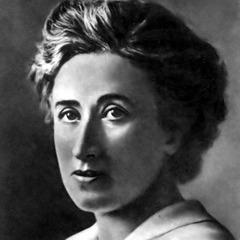
Rosa Luxemburg
Rosa Luxemburg

Rosa Luxemburg (March 5, 1871 – January 15, 1919) was a Polish-German Marxist philosopher, economist, and revolutionary. She was a key figure in the German Social Democratic Party and a co-founder of the Communist Party of Germany. Known for her critique of capitalism, theory of imperialism, and advocacy for socialist democracy, she opposed World War I and was imprisoned for her anti-war activities. Luxemburg was murdered by right-wing paramilitaries during the German Revolution of 1919. Her works, including 'The Accumulation of Capital' and 'The Russian Revolution,' remain influential in Marxist theory. more

You May Also Like

“Freedom is the possibility of isolation. You are free if you can withdraw from people, not having to seek them out for the sake of money, company, love, glory or curiosity, none of which can thrive in silence and solitude. If you can't live alone, you were born a slave. You may have all the splendours of the mind and the soul, in which case you're a noble slave, or an intelligent servant, but you're not free. And you can't hold this up as your own tragedy, for your birth is a tragedy of Fate alone. Hapless you are, however, if life itself so oppresses you that you're forced to become a slave. Hapless you are if, having been born free, with the capacity to be isolated and self-sufficient, poverty should force you to live with others.”

“Life is not a list of checkboxes that we have to tick off sequentially one after another. Got a degree? Tick. Booked a house under my name? Tick. Got married? Tick. Had Children? Tick. All this sound too cliché, too depressing. These are acts which people do under the influence of peer pressure, mimicking each other, and not willingly as a genuine choice of their own.”

“… the primitive comprehension that the state property represents a social one, their identification, and their equalization  could not resist the criticism of the time. The state property is not socialism. The state-monopoly property, as it was on the both sides of the Berlin Wall and which continues to be such one even after it dropped down, is not social property. There was never and nowhere any socialism! In the twentieth century, we passed through a system of utopian socialism as proof that this was not socialism that was not possible, but the utopia of the writers before Marx and after Marx. We were visited by a utopian socialism, which at the contemporary stage is simply capitalism—state, monopolistic.”

“The fundamentalist seeks to bring down a great deal more than buildings. Such people are against, to offer just a brief list, freedom of speech, a multi-party political system, universal adult suffrage, accountable government, Jews, homosexuals, women's rights, pluralism, secularism, short skirts, dancing, beardlessness, evolution theory, sex. There are tyrants, not Muslims. United Nations Secretary-General Kofi Annan has said that we should now define ourselves not only by what we are for but by what we are against. I would reverse that proposition, because in the present instance what we are against is a no brainer. Suicidist assassins ram wide-bodied aircraft into the World Trade Center and Pentagon and kill thousands of people: um, I'm against that. But what are we for? What will we risk our lives to defend? Can we unanimously concur that all the items in the preceding list -- yes, even the short skirts and the dancing -- are worth dying for? The fundamentalist believes that we believe in nothing. In his world-view, he has his absolute certainties, while we are sunk in sybaritic indulgences. To prove him wrong, we must first know that he is wrong. We must agree on what matters: kissing in public places, bacon sandwiches, disagreement, cutting-edge fashion, literature, generosity, water, a more equitable distribution of the world's resources, movies, music, freedom of thought, beauty, love. These will be our weapons. Not by making war but by the unafraid way we choose to live shall we defeat them. How to defeat terrorism? Don't be terrorized. Don't let fear rule your life. Even if you are scared.”

“We may indeed die here, that's true. But we will all die anyway-is there any denying that? When you think of all the possible ways you might go, this is as fine a place as any, isn't it? I mean, to end one's life surrounded by friends, in a comfortable, dry room with plenty to read... that doesn't sound too awful, does it?" "What is the advantage of fear, or the benefit of regret, or the bonus of granting misery a foothold even if death is embracing you? My old abbot used to say, 'Life is only precious if you wish it to be.' I look at it like the last bite of a wonderful meal-do you enjoy it, or does the knowledge that there is no more to follow make it so bitter that you would ruin the experience?" The monk looked around, but no one answered him. "If Maribor wishes for me to die, who am I to argue? After all, it is he who gave me life to begin with. Until he decides I am done, each day is a gift granted to me, and it would be wasted if spent poorly. Besides, for me, I've learned that the last bite is often the sweetest.”

“Death isn't empty like you say it is. Emptiness is life without freedom, Darrow. Emptiness is living chained by fear, fear of loss, of death. I say we break those chains. Break the chains of fear and you break the chains that bind us to the Golds, to the Society. Could you imagine it? Mars could be ours. It could belong to the colonists who slaved here, died here." Her face is easier to see as the night fades through the clear roof. It is alive, on fire. "If you led the others to freedom. The things you could do, Darrow. The things you could make happen." She pauses and I see her eyes are glistening. "It chills me. You have been given so, so much, but you set your sights so low." "You repeat the same damn points," I say bitterly. "You think a dream is worth dying for. I say it isn't. You say it's better to die on your feet. I say it's better to live on our knees." "You're not even listening!" she snaps. "We are machine men with machine minds, machine lives …" "And machine hearts?" I ask. "That's what I am?" "Darrow …" "What do you live for?" I ask her suddenly. "Is it for me? Is it for family and love? Or is it just for some dream?" "It's not just some dream, Darrow. I live for the dream that my children will be born free. That they will be what they like. That they will own the land their father gave them." "I live for you," I say sadly. She kisses my cheek. "Then you must live for more.”