Quotessence
Home / Quotes / Quote by Ludwig von Mises

Quote by Ludwig von Mises

“No very deep knowledge of economics is usually needed for grasping the immediate effects of a measure; but the task of economics is to foretell the remoter effects, and so to allow us to avoid such acts as attempt to remedy a present ill by sowing the seeds of a much greater ill for the future.”

Quote by Ludwig von Mises

Work

The Theory of Money and Credit

This book delves into the intricate relationship between money and credit, examining their roles in the functioning of an economy. It analyzes the theoretical underpinnings of monetary and credit systems, offering insights into their impact on economic stability and growth. more

Author
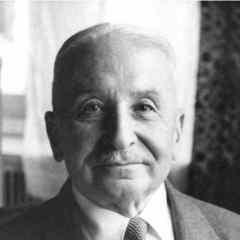
Ludwig von Mises
Ludwig von Mises

Ludwig von Mises was a prominent economist, philosopher, and social theorist born on September 29, 1881, in Austria, and passed away on October 10, 1973. He is considered one of the most influential economists of the 20th century and a leading advocate for free-market economics. more

You May Also Like

“The direction of all economic affairs is in the market society a task of the entrepreneurs. Theirs is the control of production. They are at the helm and steer the ship. A superficial observer would believe that they are supreme. But they are not. They are bound to obey unconditionally the captain's orders.”

“To the grumbler who complains about the unfairness of the market system only one piece of advice can be given: If you want to acquire wealth, then try to satisfy the public by offering them something that is cheaper or which they like better....Equality under the law gives you the power to challenge every millionaire.”

“The "progressives" who today masquerade as "liberals" may rant against "fascism"; yet it is their policy that paves the way for Hitlerism. Nothing could have been more helpful to the success of the National-Socialist (Nazi) movement than the methods used by the "progressives," denouncing Nazism as a party serving the interests of "capital." The German workers knew this tactic too well to be deceived by it again.”

“He who acts under an emotional impulse also acts. What distinguishes an emotional action from other actions is the valuation of input and output. Emotions disarrange valuations. Inflamed with passion, man sees the goal as more desirable and the price he has to pay for it as less burdensome than he would in cool deliberation.”