Quotessence
Home / Quotes / Quote by Amandla Stenberg

Quote by Amandla Stenberg

“I oftentimes receive the question, "What do you think is the most important social issue to focus on?" Or, "What's the most important component of identity? Is it gay rights or race or feminism?" And I'm like, "Well, they're all intertwined. It's all one conversation at the end of the day. You can't just pick one." I mean, people experience all kinds of prejudice because of all different parts of themselves. And that doesn't make one part more important than the other.”

Quote by Amandla Stenberg

Author
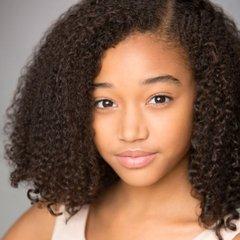
Amandla Stenberg
Amandla Stenberg

Amandla Stenberg is an American actress born on October 23, 1998. She gained widespread acclaim for her role as Jo March in the film 'Little Women' and international recognition for her portrayal of Princess T'Challa in 'Black Panther'. more

You May Also Like

“I hope one day it's not revolutionary just to be yourself, but I think that the work that's being done around identity and personhood is so important.I feel inspired by people around me who are part of this movement as well: Hari Nef and Rowan Blanchard and Willow Smith and these kids who are really not going to listen to anyone. "I'm just going to say whatever I feel. I'm going to be myself. And if you don't like it, then, you can go screw yourself."”

“What interested me in film was the image-making aspect of it. So, I went to school in cinematography. I was really convinced that image was what I wanted to do, and I think it came from the fact that I lived in a small town my whole life, but my mother was very interested in painting, so she would bring us to Paris for two weeks. So, we're going to the Louvre and to the museums and to see shows. In the evening we were seeing theater. Painting is basically what led me. I think the image was key.”

“When the cinematography school told me I would have no chance to get a job, I said, "It's irrelevant." My mom was a feminist in the '20s. She taught me to be on my own, to be independent, to do what I wanted to do. I did not believe it would be difficult. It was difficult. In '66, I almost starved for a year and a half, and the only way I did not starve was because I could not find a job in camera, but I found a job in editing.”

“In the '60s when I started to see everything I could see, you could see pretty much everything which was still available from the '30s, '40s, '50s, '60s, and therefore I had an education which was really large and vast in different cinema. That's probably the reason I did not fall for the New Wave. It's really the love of the movies that made me want to become a cameraperson, definitely. I was really a film buff.”

“I met Michael Snow and Stan Brakhage the second day after I arrived, you know. I had never seen or heard of Brakhage. For me, it was a revolution, because I was well educated in film, but American-style experimental film was known to me in the abstract, and I had seen practically nothing. I had seen a film then that Noël Burch had found and was distributing called Echoes of Silence. It was a beautiful film, three hours long. It goes forever and it was in black and white, very grainy, and I saw that film and I thought...it was not New Wave. It was really a new concept of cinema.”