Quotessence
Home / Quotes / Quote by Galileo Galilei

Quote by Galileo Galilei

“Philosophy [nature] is written in that great book which ever is before our eyes -- I mean the universe -- but we cannot understand it if we do not first learn the language and grasp the symbols in which it is written. The book is written in mathematical language, and the symbols are triangles, circles and other geometrical figures, without whose help it is impossible to comprehend a single word of it; without which one wanders in vain through a dark labyrinth.”

Quote by Galileo Galilei

Author
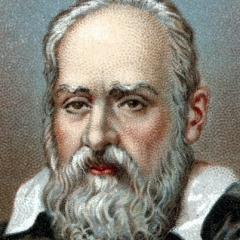
Galileo Galilei
Galileo Galilei

Galileo Galilei, an Italian physicist, astronomer, mathematician, and philosopher, is considered the father of modern science. He was born on February 15, 1564, and died on January 8, 1642. Galileo made significant contributions to the fields of physics, astronomy, mathematics, and philosophy. He discovered the four moons of Jupiter through his telescope, supporting Copernicus' heliocentric model, and proposed the law of free fall and other scientific theories. more

You May Also Like

“Kings built tombs more splendid than the houses of the living and counted the names of their descent dearer than the names of their sons. Childless lords sat in aged halls musing on heraldry or in high cold towers asking questions of the stars. And so the kingdom of Gondor sank into ruin, the line of kings failed, the white tree withered and the rule of Gondor was given over to lesser men.”

“It had been startling and disappointing to me to find out that story books had been written by people, that books were not natural wonders, coming up of themselves like grass. Yet regardless of where they come from, I cannot remember a time when I was not in love with them - with the books themselves, cover and binding and the paper they were printed on, with their smell and their weight and with their possession in my arms, captured and carried off to myself. Still illiterate, I was ready for them, committed to all the reading I could give them.”

“Sometimes," I ventured, "it doesn't occur to boys that their mother was ever young and pretty. . . I couldn't stand it if you boys were inconsiderate, or thought of her as if she were just somebody who looked after you. You see I was very much in love with your mother once, and I know there's nobody like her.”

“I want first of all - in fact, as an end to these other desires - to be at peace with myself. I want a singleness of eye, a purity of intention, a central core to my life that will enable me to carry out these obligations and activities as well as I can. I want, in fact - to borrow from the language of the saints - to live 'in grace' as much of the time as possible. I am not using this term in a strictly theological sense. By grace I mean an inner harmony, essentially spiritual, which can be translated into outward harmony.”