Quotessence
Home / Quotes / Quote by Bayard Rustin

Quote by Bayard Rustin

“Birmingham has proved that no matter what you're up against, if wave after wave of black people keep coming prepared to go to jail, sooner or later there is such confusion, such social dislocation, that white people in the South are faced with a choice: either integrated restaurants or no restaurants at all, integrated public facilities or none at all. And the South then must make its choice for integration, for it would rather have that than chaos. This struggle is only beginning in the North, but it will be a bitter struggle. It will be an attack on business, on trade unions, and on the government. The Negro will no longer tolerate a situation where for every white man unemployed there are two or three Negroes unemployed. In the North, Negroes present a growing threat to the social order that, less brutally and more subtly than the South, attempts to keep him "in his place." In response, moderates today warn of the danger of violence and "extremism" but do not attempt to change conditions that brutalize the Negro and breed racial conflict. What is needed is an ongoing massive assault on racist political power and institutions.”

Quote by Bayard Rustin

Work

Down the Line: The Collected Writings of Bayard Rustin

Browse quotes and source details for this work. more

Author
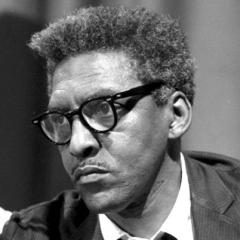
Bayard Rustin
Bayard Rustin

Bayard Rustin was a prominent African American civil rights activist who played a significant role in the American civil rights movement. He was a strategist and advisor to many civil rights leaders, including Martin Luther King Jr. Rustin was a key figure in the organization of the 1963 March on Washington for Jobs and Freedom, one of the largest political protests in U.S. history. He was also a leader in the gay rights movement and advocated for nonviolent protest and civil disobedience. more

You May Also Like

“The traditional reluctance in this country to confront the real nature of racism is once again illustrated by the manner in which the majority of American whites interpreted what the Kerner Commission had to say about white racism. It seems that they have taken the Kerner Report as a call merely to examine their individual attitudes. The examination of individual attitudes is, of course, an indispensable requirement if the influence of racism is to be neutralized, but it is neither the only nor the basic requirement. The Kerner Report took great pains to make a distinction between racist attitudes and racist behavior. In doing so, it was trying to point out that the fundamental problem lies in the racist behavior of American institutions toward Negroes, and that the behavior of these institutions is influenced more by overt racist actions of people than by their private attitudes. If so, then the basic requirement is for white Americans, while not ignoring the necessity for a revision of their private beliefs, to concentrate on actions that can lead to the ultimate democratization of American institutions. By focusing upon private attitudes alone, white Americans may come to rely on token individual gestures as a way of absolving themselves personally of racism, while ignoring the work that needs to be done within public institutions to eradicate social and economic problems and redistribute wealth and opportunity. I mean by this that there are many whites sitting around in drawing rooms and board rooms discussing their consciences and even donating a few dollars to honor the memory of Dr. King. But they are not prepared to fight politically for the kind of liberal Congress the country needs to eradicate some of the evils of racism, or for the massive programs needed for the social and economic reconstruction of the black and white poor, or for a revision of the tax structure whereby the real burden will be lifted from the shoulders of those who don't have it and placed on the shoulders of those who can afford it. Our time offers enough evidence to show that racism and intolerance are not unique American phenomena. The relationship between the upper and lower classes in India is in some ways more brutal than the operation of racism in America. And in Nigeria black tribes have recently been killing other black tribes in behalf of social and political privilege. But it is the nature of the society which determines whether such conflicts will last, whether racism and intolerance will remain as proper issues to be socially and politically organized. If the society is a just society, if it is one which places a premium on social justice and human rights, then racism and intolerance cannot survive —will, at least, be reduced to a minimum. While working with the NAACP some years ago to integrate the University of Texas, I was assailed with a battery of arguments as to why Negroes should not be let in. They would be raping white girls as soon as they came in; they were dirty and did not wash; they were dumb and could not learn; they were uncouth and ate with their fingers. These attitudes were not destroyed because the NAACP psychoanalyzed white students or held seminars to teach them about black people. They were destroyed because Thurgood Marshall got the Supreme Court to rule against and destroy the institution of segregated education. At that point, the private views of white students became irrelevant. So while there can be no argument that progress depends both on the revision of private attitudes and a change in institutions, the onus must be placed on institutional change. If the institutions of this society are altered to work for black people, to respond to their needs and legitimate aspirations, then it will ultimately be a matter of supreme indifference to them whether white people like them, or what white people whisper about them in the privacy of their drawing rooms.”

“The petition argued that the Court's decision was a dire mistake; if the decision were allowed to stand and prosecutors were compelled to explain gross racial disparities such as the ones at issue, it would...'paralyze the criminal justice system'—apparently because severe and inexplicable racial disparities pervaded the system as a whole.”

“Despite the fact that this scene played out over and over in registrars' offices across the South—where a registrar in Mississippi could even ask African Americans, "How many bubbles in a bar of soap?" —the law itself was just race-neutral enough to withstand judicial scrutiny.”

“We are not to forget, either, that Africa is inhabited by various tribes or nations of negroes--some more and some less degraded than the average...the white race exhibits some qualities of superiority over any other...The secret of the greater intelligence and aptitude of the Caucasian undoubtedly in great measure is to be attributed to the commingling of blood amongst its various branches; and this was evidently forced in large measure by circumstances under divine control.”

“But of course it makes sense because we are Third Worlders and Third Worlders are forward-looking, we like things to be new, because our best is still ahead, while in the West their best is already past and so they have to make a fetish of that past.Remember this is our newly middle-class world. We haven’t completed the first cycle of prosperity, before going back to the beginning again, to drink milk from the cow’s udder.”