Quotessence
Home / Quotes / Quote by Ken Wilber

Quote by Ken Wilber

“My opinion is that we have, in the person of Da Free John, a Spiritual Master and religious genius of the ultimate degree. I assure you I do not mean that lightly. I am not tossing out high-powered phrases to 'hype' the works of Da Free John. I am simply offering to you my own considered opinion: Da Free John's teaching is, I believe, unsurpassed by that of any other spiritual Hero, of any period, of any place, of any time, of any persuasion.”

Quote by Ken Wilber

Author
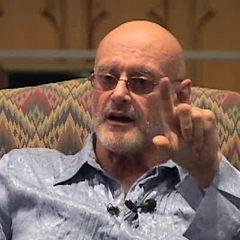
Ken Wilber
Ken Wilber

Ken Wilber is an American writer and philosopher, born on January 31, 1949. He is the founder of Integral Theory, which aims to integrate human knowledge, philosophy, psychology, and religion. Wilber's work covers a wide range of fields, including personal growth, spiritual development, and cultural studies. more

You May Also Like

“Donald Judd spoke of a 'neutral' surface, but what is meant? Neutrality must involve some relationship (to other ways of painting, thinking?) He would have to include these in his work to establish the neutrality of that surface. He also used 'non' or 'not' - expressive - this is an early problem - a negative solution or - expression of new sense - which can help one into - what one has not known. 'Neutral' expresses an intention.”

“Marcel Duchamp, one of this century's pioneers, moved his work through the retinal boundaries which had been established with Impressionism into a field where language, thought and vision act upon one another. There it changed form through a complex interplay of new mental and physical materials, heralding many of the technical, mental and visual details to be found in more recent art... He declared that he wanted to kill art ("for myself") but his persistent attempts to destroy frames of reference altered our thinking, established new units of thought, a "new thought for that object."”

“Object in/ and space - the first impulse may be to give the object - a position - to place the object. (The object had a position to begin with.) Next - to change the position of the object. - Rauschenberg's early sculptures - A board with some rocks on it. The rocks can be anywhere on the board. - Cage's Japanese rock garden - The rocks can be anywhere (within the garden).”