Quotessence
Home / Quotes / Quote by Markus Zusak

Quote by Markus Zusak

Work

The Book Thief

This novel is a poignant story of survival and the power of literature. Narrated by Death, it follows the life of Liesel Meminger, a girl who is sent to live with a German family during the tumultuous years of World War II. Liesel becomes deeply involved with her foster family, learning to read and write, and finding solace in books amidst the chaos of the war. The story explores themes of love, loss, and the human spirit in the face of adversity. more
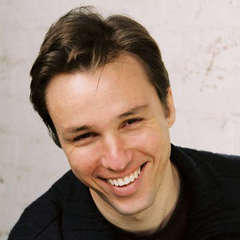
Author

Markus Zusak
Markus Zusak

Markus Zusak, born on June 23, 1975, is an acclaimed Australian author known for his unique narrative style and profound thematic insights. His works have garnered widespread praise from readers and critics alike. more

You May Also Like

“Why didn't I feel like this when we were actually together?" "Maybe... maybe your mango wasn't ripe." I squinted at Cat. "I'm not following. You're going to have to take me there." "There's a part in You've Got Mail when Kathleen and Joe have been hanging out together. Joe knows their online identities, but she doesn't. And they go to the farmers' market, and before parting ways she says, 'I hope your mango's ripe,' and he gives her this considering look and tells her that he thinks it is." "That is a very obscure reference." "The point is, the mango was a metaphor for their relationship. He'd waited until she'd grown and softened under the sunlight, and once she'd gotten there, he made his move---both before and after revealing his identity.”

“The code is a metaphor that works well for the genetic code or the rules of a cellular automaton. The code is bad metaphor for the continuously changing states of neurons as they run through their algorithmic programs. Imagine looking for a code in space and time for rule 110, iteration 1,234, position 820-870. To study the mechanism that led to that state, we look at the point before, the relation of how it happened, in all available detail. Is that useful? In the case of the rule 110 automaton, the same rule applies everywhere, so the instance reveals something general about the whole. This is the hope of the biological experiment as well. But what happens if the rule changes with every iteration, as discussed for transcription factor cascades? To describe changing rules of algorithmic growth for every instance in time and space and in different systems is not only a rather large endeavor, it also suffers from the same danger of undefined depth. It is a description of the system, a series of bits of endpoint information, not a description of a code sufficient to create the system. The code is the 'extremely small amount of information to be specified genetically,' as Willshaw and von der Malsburg put it, that is sufficient to encode the unfolding of information under the influence of time and energy. The self-assembling brain.”

“The world had changed its attire in spring and what it was wearing now was a perfect fit to what it was deep inside: a controlling old slag who didn't care about anyone’s wishes and would ignore everyone who wouldn't live by her rules. Tom was finished with that cunt: the world behind the fogged up windows. He used to live in one of his own: a dirty but well-protected one that nobody had ever entered, since everyone who even tried was to be shot before they could make it over the threshold.”