Quotessence
Home / Quotes / Quote by Chris Hedges

Quote by Chris Hedges

“if we don’t rebel, if we’re not physically in an active rebellion, then it’s spiritual death.”

Quote by Chris Hedges

Author
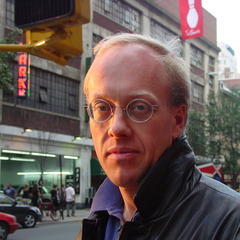
Chris Hedges
Chris Hedges

Chris Hedges is an American author, journalist, and activist renowned for his incisive critique of American politics and society. He specializes in examining issues such as corporate power, social inequality, and the consequences of war. Hedges has penned several notable books, such as 'War Is a Force That Gives Us Meaning' and 'American Fascists: The Christian Right and the War on America'. He has contributed to various publications, including The New York Times and The Nation. more

You May Also Like

“But now what? Why, now comes my master, takes me right away from my work, and my friends, and all I like, and grinds me down into the very dirt! And why? Because, he says, I forgot who I was; he says, to teach me that I am only a nigger! After all, and last of all, he comes between me and my wife, and says I shall give her up, and live with another woman. And all this your laws give him power to do, in spite of God or man. Mr. Wilson, look at it! There isn't one of all these things, that have broken the hearts of my mother and my sister, and my wife and myself, but your laws allow, and give every man power to do, in Kentucky, and none can say to him nay! Do you call these the laws of my country? Sir, I haven't any country, anymore than I have any father. But I'm going to have one. I don't want anything of your country, except to be let alone,--to go peaceably out of it; and when I get to Canada, where the laws will own me and protect me, that shall be my country, and its laws I will obey. But if any man tries to stop me, let him take care, for I am desperate. I'll fight for my liberty to the last breath I breathe. You say your fathers did it; if it was right for them, it is right for me!”

“If you accept a democratic system, this means that you are prepared to put up with those of its workings, legislative or administrative, with which you do not agree as well as with those that meet with your concurrence. This willingness to accept, in principle, the workings of a system based on the will of the majority, even when you yourself are in the minority, is simply the essence of democracy. Without it there could be no system of representative self-government at all. When you attempt to alter the workings of the system by means of violence or civil disobedience, this, it seems to me, can have only one of two implications; either you do not believe in democracy at all and consider that society ought to be governed by enlightened minorities such as the one to which you, of course, belong; or you consider that the present system is so imperfect that it is not truly representative, that it no longer serves adequately as a vehicle for the will of the majority, and that this leaves to the unsatisfied no adequate means of self-expression other than the primitive one of calling attention to themselves and their emotions by mass demonstrations and mass defiance of established authority.”

“Acts of civil disobedience were neither the sheer lawlessness of criminals nor the rejection of law itself by anarchists and terrorists. Instead, in civil disobedience, Hannah Arendt saw how the moral act of individual conscience—I cannot live with myself if I consent to this—could sometimes also become a political act. Civil disobedience happens when people are not heard and when a significant number of people see that their government is clearly heading in a lawless direction. The civil disobedient, Arendt said, acts in the name and for the sake of a group; he defies the law and the established authorities on the ground of basic dissent. The civil disobedient is not lawless, she is acting together with others precisely in the spirit of the laws—breathing together, Arendt says.”