“But every state, says an inquisitor, has established some religion. No two, say I, have established the same. Is this a proof of the infallibility of establishments?”
Quote by Thomas Jefferson
Work
The portable Thomas Jefferson
This volume offers a wide-ranging selection of Thomas Jefferson's writings, showcasing his intellectual contributions across various domains such as politics, philosophy, and personal life. It includes his seminal Declaration of Independence, letters to friends and contemporaries, and his thoughts on issues of the day. The Portable Thomas Jefferson provides insight into Jefferson's character and his influence on American history. more
Author
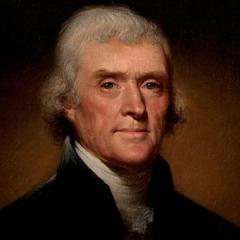
Thomas Jefferson
Thomas Jefferson was the third President of the United States, a distinguished politician, philosopher, architect, and scientist. He was born on April 13, 1743, and died on July 4, 1826. Jefferson advocated for democracy and freedom in politics and was one of the main authors of the Declaration of Independence. His political ideas had a profound impact on the founding and development of the United States. more
You May Also Like
Source: The Papers of Thomas Jefferson, Retirement Series, Volume 8: 1 October 1814 to 31 August 1815: 1 October 1814 to 31 August 1815
Source: The writings of Thomas Jefferson
Source: Memoir, Correspondence, and Miscellanies, from the Papers of Thomas Jefferson
Source: The Papers of Thomas Jefferson, Retirement Series, Volume 7: 28 November 1813 to 30 September 1814
“Nothing but free argument, raillery and even ridicule will preserve the purity of religion.”
Source: The Commonplace Book of Thomas Jefferson: A Repertory of His Ideas on Government, with an Introduction and Notes by Gilbert Chinard
Source: The writings of Thomas Jefferson
“I think risk-taking is a great adventure. And life should be full of adventures.”
“I trust there is not a young man now living in the United States who will not die a Unitarian.”
Source: Memoirs, Correspondence, and Private Papers of Thomas Jefferson: Late President of the United States
Source: Jefferson: Political Writings