Quotessence
Home / Quotes / Quote by Bryan Stevenson

Quote by Bryan Stevenson

“In Alabama, even though 65 percent of all homicide victims were black, nearly 80 percent of the people on death row were there for crimes against victims who were white.”

Quote by Bryan Stevenson

Work

Just Mercy

Browse quotes and source details for this work. more
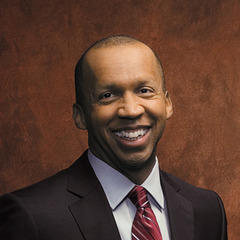
Author

Bryan Stevenson
Bryan Stevenson

Bryan Stevenson is an American lawyer, educator, and social activist known for his contributions to criminal justice reform and the defense of the rights of the poor. Born on November 14, 1959, Stevenson is a professor at the University of Alabama at Birmingham School of Law. more

You May Also Like

“Every few months, white people trot out a new title in a series called Cops Keep Killing People. Each new release has the latest tragic scene on the cover. It sure seems to be the same book recycled over and over, but please don't form a judgment until you read all five hundred pages. Maybe this time the story will end differently and the cops will be the hero!”

“Not having a group consciousness, whites often respond defensively when grouped with other whites, resenting what they see as unfair generalizations. Individualism prevents us from seeing ourselves as responsible for or accountable to other whites as members of a shared racial group that collectively benefits from racial inequality.”

“Judge Fisher permitted the defendants to explain how their opposition to the war had caused them to commit an act of resistance. He also permitted them to call as witnesses a wide range of people who supported resistance to the war, including both Daniel and Philip Berrigan. One by one, defense witnesses spoke of resistance to the government's war policy as an admired virtue central to understanding of American history and to maintaining a just society. One of the surprising witnesses was Major Clement St. Martin, the commander of the New Jersey State induction center in Newark from 1968 to 1971. Files under his control had been destroyed by the defendants. Nevertheless, he testified in their defense.He said he had become completely frustrated after years of making futile complaints through appropriate channels about the gross corruption in the way the draft forced the sons of the poor to serve in Vietnam and released the sons of the rich and sons of state and federal officials from service. His frustrations had grown particularly deep, he testified, in 1969 when a "very high" Selective Service official, responding to complaints filed by the major, told him, "Mind your business. We have twenty million animals to chose from.”

“Events in the African American town of Hamburg, in the Edgefield District of South Carolina, were typical of many others across the former Confederacy where white paramilitary groups mobilized to regain control of state governments. Their aim was simple: prevent African Americans from voting. In July 1876, a few months before the election that gave the presidency to Hayes, a violent rampage in Hamburg abolished the civil rights of freed slaves. Calling itself the Red Shirts, a collection of white supremacists killed six African American men and then murdered four others whom the gang had captured. Benjamin Tillman led the Red shirts; the massacre propelled him to a twenty-four-year career as the most vitriolic racist in the U.S. Senate. Following the massacre, the terror did not abate. In September, a 'rifle club' of more than 500 whites crossed the Savannah River from Georgia and camped outside Hamburg. A local judge begged the governor to protect the African American population, but to no avail. The rifle club then moved on to the nearby hamlet of Ellenton, killing as many as fifty African Americans. President Ulysses S. Grant then sent in federal troops, who temporarily calmed things down but did not eliminate the ongoing threats. Employers in the Edgefield District told African Americans they would be fired, and landowners threatened black sharecroppers with eviction if they voted to maintain a biracial state government. When the 1876 election took place, fraudulent white ballots were cast; the total vote in Edgefield substantially exceeded the entire voting age population. Results like these across the state gave segregationist Democrats the margin of victory they needed to seize control of South Carolina's government from the black-white coalition that had held office during Reconstruction. Senator Tillman later bragged that 'the leading white men of Edgefield' had decided to 'seize the first opportunity that the Negroes might offer them to provoke a riot and teach the Negroes a lesson.' Although a coroner's jury indicted Tillman and ninety-three other Red Shirts for the murders, they were never prosecuted and continued to menace African Americans. Federal troops never came to offer protection. The campaign in Edgefield was of a pattern followed not only in South Carolina but throughout the South. With African Americans disenfranchised and white supremacists in control, South Carolina instituted a system of segregation and exploitation that persisted for the next century. In 1940, the state legislature erected a statute honoring Tillman on the capitol grounds, and in 1946 Clemson, one of the state's public universities, renamed its main hall in Tillman's honor. It was in this environment that hundreds of thousands of African Americans fled the former Confederacy in the first half of the twentieth century.”

“Of course innocent mistakes occur, but the accumulated insults and indignations caused by racial presumptions are destructive in ways that are hard to measure. Constantly being suspected, accused, watched, doubted, distrusted, presumed guilty, and even feared is a burden borne by people of color that can't be understood or confronted without a deeper conversation about our history of racial injustice.”