Quotessence
Home / Quotes / Quote by Leon Trotsky

Quote by Leon Trotsky

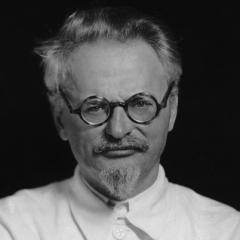
“Stalinism in turn is not an abstraction of “dictatorship”, but an immense bureaucratic reaction against the proletarian dictatorship in a backward and isolated country. The October Revolution abolished privileges, waged war against social inequality, replaced the bureaucracy with self-government of the toilers, abolished secret diplomacy, strove to render all social relationship completely transparent. Stalinism reestablished the most offensive forms of privileges, imbued inequality with a provocative character, strangled mass self-activity under police absolutism, transformed administration into a monopoly of the Kremlin oligarchy and regenerated the fetishism of power in forms that absolute monarchy dared not dream of.”

Quote by Leon Trotsky

Work

The New Course

Browse quotes and source details for this work. more

Author

Leon Trotsky
Leon Trotsky

Leon Trotsky was a Russian revolutionary, politician, and theorist, one of the key figures in Marxist theory. Born on November 7, 1879, and died on August 21, 1940. Trotsky played a significant role in the Russian Revolution, being one of the founders of the Bolshevik Party and a close comrade of Lenin. He was involved in the political struggles after the revolution and eventually fell out with Stalin, leading to his exile and eventual assassination. more

You May Also Like

“Two weeks later General Kaledin received a deputation from his troops. 'Will you,' the asked, 'promise to divide the estates of the Cossack landlords among the working Cossacks?' 'Only over my dead body,' responded Kaledin. A month later, seeing his army melt away before his eyes, Kaledin blew out his brains. And the Cossack movement was no more...”

“Lev Davidovich contemplated the Norwegian landscape and, as he would write shortly afterward, made a silent tally of his exile, to confirm that the losses and frustrations were many more than the doubtful gains. Nine years of marginalization and attacks had managed to turn him into a pariah, a new wandering Jew sentenced to ridicule and the anticipation of a terrible death that would arrive when the humiliation had exhausted its usefulness and quota for sadism. He was leaving Europe, perhaps forever - and with it the corpses of so many comrades and the tombs of his two daughters. With him, he took the faint hope that Liova and Sergei would be able to resist and, at least, escape that whirlwind with their lives intact; they were leaving the illusions, the past, the glory, and the ghosts including those of the revolution for which he had fought for so many years. 'But with me, I am also taking life,' he would write, 'and as beaten down as they think I am, while I still breathe, I have not been defeated.' P. 198”

“I am a flawed person. A brook with many stones, a clear blue sky with many blackbirds. I have many shortcomings. A rainbow that’s not long enough, a starry night with clouds. But I can only be thankful to the God who loves me just this way, and I can only be grateful to the people in my life who accept the clear blue sky with many blackbirds and who are patient with the rainbow that isn’t long enough. And because of this, I am taught love, because of this I love my God, and I love these people.”

“There was more than a little truth in Trotsky's angry accusation of April 1912, after he had suffered the theft of the title of his journal [Pravda], that Lenin nourished himself on discord and chaos. But so did all revolutionary politicians, for revolutionary changes issue from profound crises. The bloody trenches of World War I created an enormous new revolutionary constituency, and only those leaders who knew how to exploit it would be prepared for the struggles that lay ahead.”