Quotessence
Home / Quotes / Quote by George Gissing

Quote by George Gissing

“I object to the word “love” altogether. It has been vulgarised. Let us talk about compatibility. Now, I should say that, no doubt, and speaking scientifically, there is one particular woman supremely fitted to each man. I put aside consideration of circumstances; we know that circumstances will disturb any degree of abstract fitness. But in the nature of things there must be one woman whose nature is specially well adapted to harmonise with mine, or with yours. If there were any means of discovering this woman in each case, then I have no doubt it would be worth a man’s utmost effort to do so, and any amount of erotic jubilation would be reasonable when the discovery was made. But the thing is impossible, and, what’s more, we know what ridiculous fallibility people display when they imagine they have found the best substitute for that indiscoverable. This is what makes me impatient with sentimental talk about marriage. An educated man mustn’t play so into the hands of ironic destiny. Let him think he wants to marry a woman; but don’t let him exaggerate his feelings or idealise their nature.”

Quote by George Gissing

Work

New Grub Street

Charles Reade's 'New Grub Street' is a satirical portrayal of the literary scene in Victorian London. The story follows a group of struggling writers as they navigate the challenges of the publishing industry, the pursuit of fame, and the complexities of personal relationships. The novel delves into the motivations and desires of its characters, offering a critical look at the literary aspirations of the time. more

Author
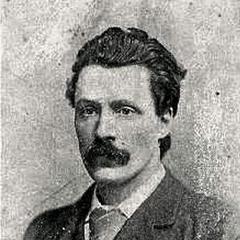
George Gissing
George Gissing

George Gissing was an English novelist known for his profound depiction of the lives of the working class. His works often focus on the struggles of the lower class and critical reflections on Victorian British society. more

You May Also Like

“From this distant vantage point, the Earth might not seem of any particular interest. But for us, it's different. Consider again that dot. That's here. That's home. That's us. On it everyone you love, everyone you know, everyone you ever heard of, every human being who ever was, lived out their lives. The aggregate of our joy and suffering, thousands of confident religions, ideologies, and economic doctrines, every hunter and forager, every hero and coward, every creator and destroyer of civilization, every king and peasant, every young couple in love, every mother and father, hopeful child, inventor and explorer, every teacher of morals, every corrupt politician, every "superstar," every "supreme leader," every saint and sinner in the history of our species lived there – on a mote of dust suspended in a sunbeam. The Earth is a very small stage in a vast cosmic arena. Think of the rivers of blood spilled by all those generals and emperors so that, in glory and triumph, they could become the momentary masters of a fraction of a dot. Think of the endless cruelties visited by the inhabitants of one corner of this pixel on the scarcely distinguishable inhabitants of some other corner, how frequent their misunderstandings, how eager they are to kill one another, how fervent their hatreds. Our posturings, our imagined self-importance, the delusion that we have some privileged position in the Universe, are challenged by this point of pale light. Our planet is a lonely speck in the great enveloping cosmic dark. In our obscurity, in all this vastness, there is no hint that help will come from elsewhere to save us from ourselves. The Earth is the only world known so far to harbor life. There is nowhere else, at least in the near future, to which our species could migrate. Visit, yes. Settle, not yet. Like it or not, for the moment the Earth is where we make our stand. It has been said that astronomy is a humbling and character-building experience. There is perhaps no better demonstration of the folly of human conceits than this distant image of our tiny world. To me, it underscores our responsibility to deal more kindly with one another, and to preserve and cherish the pale blue dot, the only home we've ever known.”

“While Humans of Cannabis in a Renaissance of Hope is filled with stories of hope, it is also a reminder of the work that remains. Thousands of people remain incarcerated in the United States for cannabis-related offenses, even as legalization sweeps across the country. The fight for justice and equity is far from over. My hope is that this book inspires readers to see cannabis not as a divisive issue but as a unifying force. Whether you are passionate about medical miracles, criminal justice reform, or community healing, these stories demonstrate the profound impact of this plant.”