Quotessence
Home / Quotes / Quote by Allyson Felix

Quote by Allyson Felix

“I definitely think I put more pressure on myself. I can be hard on myself and super-critical and very rarely satisfied or happy. I am my biggest critic.”

Quote by Allyson Felix

Author
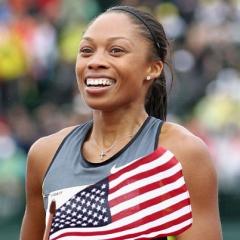
Allyson Felix
Allyson Felix

Born on November 18, 1985, Allyson Felix is a renowned track and field athlete. She has achieved numerous world records and Olympic gold medals in sprinting and relay races, becoming a top athlete in the women's sprinting field. more

You May Also Like

“As a female athlete, you're always fighting to be on a level playing field with your male counterparts. But I believe the Olympics is great for young girls; they get to be exposed to so many different sports and to these really strong women. It's an opportunity to showcase what we do, which is something that men get the opportunity to do on a pretty regular basis.”

“As a Muslim youth, though I played a variety of sports growing up in New Jersey, my parents were in search of a sport for me to play where I could be fully covered and not have to modify the uniform. Fencing provided a unique opportunity where I could fulfill my desire to participate in sport, wear the same uniform as my teammates, and adhere to the tenets of my faith to cover my body.”

“People are always shocked to hear I'm an athlete by profession and even more shocked when they hear I'm a fencer from the United States. I challenge the stereotype that Muslim women are oppressed and that a Muslim can be American by birth. It's amazing how many assumptions people make, but I embrace the opportunity to use this Olympic platform to educate.”

“The most difficult part is training and competing while observing the holy month of Ramadan, which involves fasting. The most rewarding part of being a Muslim athlete is my faith in God paired with my faith in myself. I approach every match with positivity and the belief that I can beat anyone on any given day. And in the face of defeat, I am able to learn from my mistakes and work on my weaknesses to prepare for next time.”

“In any big spectacular, it's really difficult to have enough voices to cover all the vocal parts. To give the audience the complete experience they're expecting, there is some reinforcement, some playback that everybody's hearing. Sometimes it's background vocals, but sometimes it will be actually vocal tracks. It's so hard to ensure, with no safety net ... you're not gonna get another shot at it, you have to have stability. I think it's very naïve of a lot of people to think that when you see someone open their mouth, they're really singing.”

“There seems to be something in the zeitgeist, and maybe it's a function of - I'm no analyst, nor am I a psychologist - when you look at things and say, What if I could go back and change things? I think we live in a world right now where people are asking those questions a lot. What if we could go back and change what we did? How would we change the way we handled things in the Middle East, and how would we change things with the banking industry, and how would we change economic and educational issues?”

“I'm very fortunate, and the movies that I've made, even from the very beginning, have been very eclectic. The thing for me is: Am I emotionally engaged in the idea? Is there something special about it? Does it capture my imagination? So everything that I do is simply something that turns me on. And I have the good fortune to be able to make bigger movies and television that ostensibly pay for the other ones. I don't mean literally finance the movies. But they allow me to work on things for very little pay. I do these things because I love them.”