Quotessence
Home / Quotes / Quote by Ernest Hemingway

Quote by Ernest Hemingway

Work

For Whom the Bell Tolls

This classic novel delves into the intense experiences of a group of individuals during the tumultuous Spanish Civil War. The narrative follows Robert Jordan, an American dynamiter, as he navigates the complexities of love and the harsh realities of war. The story is rich with philosophical musings on the nature of life and death, making it a profound exploration of human existence. more

Author
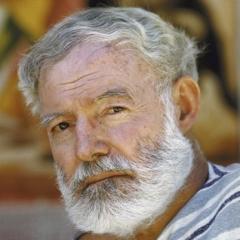
Ernest Hemingway
Ernest Hemingway

American author known for his concise and forceful writing style, as well as his profound insights into life. Hemingway's works cover a wide range of themes including war, adventure, and love, with notable titles such as 'The Old Man and the Sea' and 'A Farewell to Arms'. more

You May Also Like

“But at my back I always hear Time’s wingèd chariot hurrying near; And yonder all before us lie Deserts of vast eternity. Thy beauty shall no more be found; Nor, in thy marble vault, shall sound My echoing song; then worms shall try That long-preserved virginity, And your quaint honour turn to dust, And into ashes all my lust; The grave’s a fine and private place, But none, I think, do there embrace.”

“A man cannot realize that above such shattered bodies there are still human faces in which life goes its daily round. And this is only one hospital, a single station; there are hundreds of thousands in Germany, hundreds of thousands in France, hundreds of thousands in Russia. How senseless is everything that can ever be written, done, or thought, when such things are possible. It must be all lies and of no account when the culture of a thousand years could not prevent this stream of blood being poured out, these torture chambers in their hundreds of thousands. A hospital alone shows what war is.”

“The majority of pacifists either belong to obscure religious sects or are simply humanitarians who object to taking life and prefer not to follow their thoughts beyond that point. But there is a minority of intellectual pacifists, whose real though unacknowledged motive appears to be hatred of western democracy and admiration for totalitarianism. Pacifist propaganda usually boils down to saying that one side is as bad as the other, but if one looks closely at the writing of the younger intellectual pacifists, one finds that they do not by any means express impartial disapproval but are directed almost entirely against Britain and the United States …”

“People walk the paths of the gardens below, and the wind sings anthems in the hedges, and the big old cedars at the entrance to the maze creak. Marie-Laure imagines the electromagnetic waves traveling into and out of Michel’s machine, bending around them, just as Etienne used to describe, except now a thousand times more crisscross the air than when he lived - maybe a million times more. Torrents of text conversations, tides of cell conversations, of televisions programs, of e-mails, vast networks of fiber and wire interlaced above and beneath the city, passing through buildings, arcing between transmitters in Metro tunnels, between antennas atop buildings, from lampposts with cellular transmitters in them, commercials for Carrefour and Evian and prebaked toaster pastries flashing into space and back to earth again, I am going to be late and Maybe we should get reservations? and Pick up avocados and What did he say? and ten thousand I miss yous, fifty thousand I love yous, hate mail and appointment reminders and market updates, jewelry ads, coffee ads, furniture ads flying invisibly over the warrens of Paris, over the battlefields and tombs, over the Ardennes, over the Rhine, over Belgium and Denmark, over the scarred and ever-shifting landscape we call nations. And is it so hard to believe that souls might also travel those paths? That her father and Etienne and Madame Manec and the German boy named Werner Pfennig might harry the sky in flocks, like egrets, like terns, like starlings? That great shuttles of souls might fly about, faded but audible if you listen closely enough? They flow above the chimneys, ride the sidewalks, slip through your jacket and shirt and breastbone and lungs, and pass out through the other side, the air a library and the record of every life lived, every sentence spoken, every word transmitted still reverberating within it. Every hour, she thinks, someone for whom the war was memory falls out of the world. We rise again in the grass. In the flowers. In songs.”