Quotessence
Home / Quotes / Quote by John Steinbeck

Quote by John Steinbeck

“Once California belonged to Mexico and its land to Mexicans; and a horde of tattered feverish Americans poured in. And such was their hunger for land that they took the land, stole Sutter's land, Guerrero' s land, took the grants and broke them up and growled and quarreled over them, those frantic hungry men; and they guarded with guns the land they had stolen. They put up houses and barns, they turned the earth and planted crops. And these things were possession, and possession was ownership. The Mexicans were weak and fed. They could not resist, because they wanted nothing in the world as frantically as the Americans wanted land.”

Quote by John Steinbeck

Work

The Grapes of Wrath

John Steinbeck's 'The Grapes of Wrath' is a profound narrative that delves into the struggles of a family displaced by the Dust Bowl and their arduous trek to California in search of a better life. The novel vividly portrays the resilience and suffering of the Joad family, highlighting the systemic issues of the time, including poverty, racism, and the exploitation of the working class. more

Author

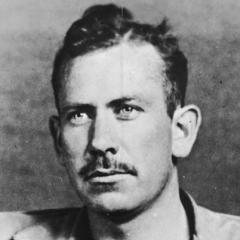
John Steinbeck
John Steinbeck

John Steinbeck was an American author renowned for his profound depiction of American society and the lives of farmers. His works often explore themes of poverty, social injustice, and human nature. Steinbeck was awarded the Nobel Prize in Literature in 1962 for his significant contribution to American literature. more

You May Also Like

“The textbooks also fail to show how the continuous Indian wars have reverberated through our culture. Carleton Beals has written that "our acquiescence in Indian dispossession has molded the American character." As soon as Natives were no longer conflict partners, their image deteriorated in the minds of many whites. Kupperman has shown how this process unfolded in Virginia after the Indian defeat in the 1640s: "It was the ultimate powerlessness of the Indians, not their racial inferiority, which made it possible to see them as people without rights." Natives who had been "ingenious," "industrious," and "quick of apprehension" in 1610 now became "sloathfull and idle, vitious, melancholy, [and] slovenly." This is another example of the process of cognitive dissonance.”

“A native is a man or creature or plant indigenous to a limited geographical area - a space boundaried and defined by mountains, rivers, or coastline (not by latitudes, longitudes, or state and county lines), with its own peculiar mixture of weeds, trees, bugs, birds, flowers, streams, hills, rocks, and critters (including people), its own nuances of rain, wind, and seasonal change. Native intelligence develops through an unspoken or soft spoken relationship with these interwoven things: it evolves as the native involves himself in his region. A non-native awakes in the morning in a body in a bed in a room in a building on a street in a county in a state in a nation. A native awakes in the in the center of a little cosmos - or a big one, if his intelligence is vast - and he wears this cosmos like a robe, senses the barely perceptible shiftings, migrations, moods, and machinations of its creatures, its growing green things, its earth and sky. Native intelligence is what Huck Finn had rafting the Mississippi, what Thoreau had by his pond, what Kerouac had in Desolation Lookout and lost entirely the instant he caught a whiff of any city. But some have it in cities - like the Artful Dodger, picking his way through a crowd of London pockets; like Mother Teresa in the Calcutta slums. Sissy Hankshaw had it on freeways, Woody Guthrie in crowds of fruit pickers, Ghandi in jails. Almost everybody has a dab of it wherever he or she feels most at home..”

“I thought about the aftermath of the 1862 war, when thirty-eight hastily condemned warriors had been hung in Mankato, in the country's largest-ever mass execution. Their bodies were buried in shallow graves and then dug up for study by local doctors, including Dr. Mayo, who kept the body of Cut Nose for his personal examination. I thought about my father losing his teaching job, about his struggle with depression and drinking. About how angry he was that our history was not taught in schools. Instead, we had to battle sports mascots and stereotypes. Movie actors in brownface. Tourists with cameras. Welfare lines. Alcoholism. 'After stealing everything,' he would rage, 'now they want to blame us for it, too.' Social services broke up Native families, sending children like me to white foster parents. Every week, the newspapers ran stories about Indians who rolled their cars while drunk or the rise of crack cocaine on the reservations or somebody's arrest for gang-related crimes. No wonder so many Native kids were committing suicide. But there was so much more to the story of the run. What people didn't see because they chose never to look. Unlike the stone monument in New Ulm, built to memorialize the settlers' loss with angry pride, the Dakhota had created a living, breathing memorial that found healing in prayer and ceremony. What the two monuments shared, however, was remembering. We were all trying to find a way through grief.”

“Before Sutter, native people had heeded the cycle of the seasons, time was infinite, and life's rhythms were unchanging. Now, for at least part of their lives, some Indians were wedded to a concept that proclaimed that time was limited and that it had economic value. The clang of Sutter's bell announced that time was money, that it marched onward, and that it waited for no man, including Indians in the 1840s.”