Quotessence
Home / Quotes / Quote by Friedrich Nietzsche

Quote by Friedrich Nietzsche

“Ich lehre euch den Übermenschen. Der Mensch ist Etwas, das überwunden werden soll. Was habt ihr gethan, ihn zu überwinden? Was ist der Affe für en Menschen? Ein Gelächter oder eine schmerzliche Scham. Und ebendas soll der Mensch für den Übermenschen sein: ein Gelächter oder eine schmerzliche Scham. Ihr habt den Weg vom Wurme zum Menschen gemacht, und Vieles ist in euch noch Wurm. Einst wart ihr Affen, und auch jetzt ist der Mensch mehr Affe, als irgend ein Affe.”

Quote by Friedrich Nietzsche

Work

Thus Spoke Zarathustra

Thus Spoke Zarathustra is a philosophical novel that delves into profound themes such as the will to power, the eternal recurrence, and the concept of the Übermensch. The book is a collection of aphorisms and dialogues narrated by the character Zarathustra, who seeks to inspire others to embrace life and strive for self-overcoming. Written by the German philosopher Friedrich Nietzsche, the work is considered a cornerstone of modern Western philosophy. more

Author
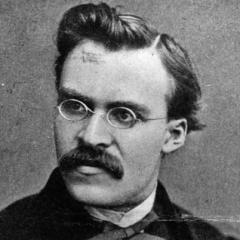
Friedrich Nietzsche
Friedrich Nietzsche

Friedrich Nietzsche was a German philosopher, cultural critic, poet, and writer whose works have had a profound impact on subsequent philosophy, literature, and thought. His ideas revolve around concepts such as the 'will to power', the 'Übermensch', and the 'eternal recurrence'. more

You May Also Like

“Grief is madness-ask anyone who's been there. They will tell you it abates with time, but that's a lie. What drowns you in the first year is a force of solitude and helplessness exactly equal in intensity to the love you had for the one who's gone. Equally passionate, equally intimate. The spaces between the the stabs of pain grow longer after a while, but they're empty spaces. The chich√(c)s of condolence get you back to the office.”

“But I also understand why Steve, who'd sewn his share of panels over the years, would fly into a rage as the end approached: 'And don't put me in that fucking quilt!' Being of a mind to have his body dumped instead on the White House lawn. The guilt had begun to seem too passive, even too nice, letting the war criminals off the hook and providing the media with far too easy a wrap up. Much neater than trying to unravel the Gordian knot of AIDS activism, the Byzantine infighting and turf protection, the in-your-face bad manners of those who wouldn't go quietly. The quilted dead made for prettier sound bites, especially effective at zeroing in on the "innocent" victims, the kids and the hemophiliacs. At the same time there began to appear a certain overview phenomenon under the general rubric of AIDS-and-the-Arts. Typically these were hand-wringing accounts of the impact of so much cultured dying, lamenting for instance the White Way silence left by Michael Bennett, the songs unsung. This litany was something of a mixed bag, bringing under the same umbrella the likes of Way Bandy and Halston, Miss Kitty and Keith Haring. Though it was surely true what Fran Lebowitz so scathingly observed If you removed all of the homosexuals and homosexual influence from what is generally regarded as American culture, you would be pretty much left with 'Let's Make a Deal.' these roundups of the arts tended to foster in the general populace ever new heights of Not me.”

“When a life is thrown from its body suddenly (by accident), or semi-suddenly (by an untimely illness), or unwillingly (by resisting death) there is damage to the system because the life-force was not prepared to leave. The exiting soul will struggle to make sense of where it is and what it is supposed to do next. It is a great gift to help someone crossover well. The person leaving will benefit from a clearer, cleaner, calmer post-Earth path. When people die, they essentially follow their instincts and leanings. Most of their human associations and attachments disintegrate. They are pulled, pushed, and drawn by their inherent tendencies. Advanced souls have a more conscious and intentional path after their passing.”

“Lyssa thought she would talk to her mother about it, and then she remembered. She had to keep remembering, even after she'd seen the body and signed the paperwork and arranged a funeral. Somehow she'd expected the dying to be the worst part, that after it was over she could go home and tell some healthy living version of her mother about the terrible thing that had just happened to her.”