Quotessence
Home / Quotes / Quote by Wernher von Braun

Quote by Wernher von Braun

Work

The Voice of Dr. Wernher Von Braun: An Anthology

This book is a compilation of essays, speeches, and interviews by Dr. Wernher von Braun, a prominent figure in the field of rocketry and space technology. It offers insights into his work on rocketry, his role in the development of the V-2 rocket, and his vision for space exploration. The anthology provides a glimpse into the mind of one of the key figures in the history of space travel. more

Author
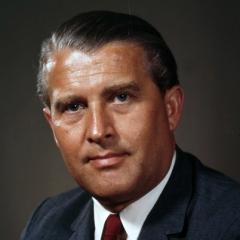
Wernher von Braun
Wernher von Braun

German rocket scientist known as the 'Father of Rocketry'. Wernher von Braun worked for Nazi Germany during World War II and continued his rocket research in the United States after the war, making significant contributions to human space exploration. more

You May Also Like

“On consideration, it is not surprising that Darwin's finches should recognize their own kind primarily by beak characters. The beak is the only prominent specific distinction, and it features conspicuously both in attacking behaviour, when the birds face each other and grip beaks, and also in courtship, when food is passed from the beak of the male to the beak of the female. Hence though the beak differences are primarily correlated with differences in food, secondarily they serve as specific recognition marks, and the birds have evolved behaviour patterns to this end.”

“On the whole, at least in the author's experience, the preparation of species-specific antiserum fractions and the differentiation of closely related species with precipitin sera for serum proteins does not succeed so regularly as with agglutinins and lysins for blood cells. This may be due to the fact that in the evolutional scale the proteins undergo continuous variations whereas cell antigens are subject to sudden changes not linked by intermediary stages.”

“All the acquisitions or losses wrought by nature on individuals, through the influence of the environment in which their race has long been placed, and hence through the influence of the predominant use or permanent disuse of any organ; all these are preserved by reproduction to the new individuals which arise, provided that the acquired modifications are common to both sexes, or at least to the individuals which produce the young.”

“So says the most ancient book of the Earth; thus it is written on its leaves of marble, lime, sand, slate, and clay: ... that our Earth has fashioned itself, from its chaos of substances and powers, through the animating warmth of the creative spirit, to a peculiar and original whole, by a series of preparatory revolutions, till at last the crown of its creation, the exquisite and tender creature man, was enabled to appear.”

“The chemical differences among various species and genera of animals and plants are certainly as significant for the history of their origins as the differences in form. If we could define clearly the differences in molecular constitution and functions of different kinds of organisms, there would be possible a more illuminating and deeper understanding of question of the evolutionary reactions of organisms than could ever be expected from morphological considerations.”