Quotessence
Home / Quotes / Quote by Leo Tolstoy

Quote by Leo Tolstoy

“Kitty se hotărî să caute și ea nenorociți, oriunde s-ar fi aflat, să-i ajute din toate puterile, să le împartă Evanghelii și să citească din ele bolnavilor, criminalilor, muribunzilor. O ispitea mai ales gândul de a le citi ucigașilor.”

Quote by Leo Tolstoy

Work

ANNA KARENINA

Anna Karenina is a profound literary work that delves into the complexities of human relationships and the impact of societal expectations on individual lives. The story follows the tragic fate of Anna, a married woman who falls in love with Count Vronsky, leading to a series of dramatic events that challenge the moral and social fabric of her world. more

Author

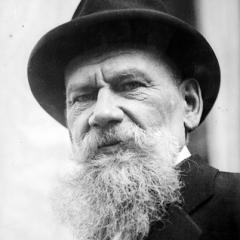
Leo Tolstoy
Leo Tolstoy

Leo Tolstoy was a Russian writer and thinker, a prominent representative of 19th-century Russian literature. His works deeply revealed social contradictions and human nature, and had a profound impact on the world. more

You May Also Like

“Ona ništa ne radi, i sasvim je zadovoljna." Ljevin je to u duši osuđivao; a još nije poimao da se ona baš sprema za period rada koji za nju mora nastupiti, kada će istovremeno biti i žena svoga muža, i domaćica u kući, i kada će nositi, hraniti i vaspitavati decu. On nije poimao da ona to zna čulom, i spremajući se za taj strašni posao ne ukorava sebe za trenutke bezbrižnosti i ljubavne sreće kojima se sada veselo koristi dok svija svoje buduće gnezdo.”

“My politically charged coming-of-age story Voices in the Forest brings the futility of the bygone Croatian marriages to the fore. If the pretty but obtuse image of Fairy of Velebit personifies the Queen of Croatia, it would be better for Croats to dethrone her and put equally beautiful but the shrewd image of Zsa Zsa Gabor in her place. It would give Croatia a new angle how to manage her future marriages while still sexy and in demand. Remember, every marriage a box of diamonds and a house.”

“Blackbeard the pirate was actually Edward Teach sometimes known as Edward Thatch, who lived from 1680 until his death on November 22, 1718. Blackbeard was a notorious English pirate who sailed around the eastern coast of North America. Although little is known about his childhood he may have worked as an apprentice on an English ship, during the second phase in a series of wars between the French and the English from 1754 and ended in 1778 as part of the American Revolutionary War. The war had different names depending on where it was fought. In the American colonies the war was known as the French and Indian War. During the time it was fought during the reign of Anne, Queen of Great Britain, it was called Queen Anne's War and in Europe it was known as the War of the Spanish Succession. During the earlier period of hostilities between France and England, some English ships were granted permission to raid French colonies and French ships and were considered privateers. Captain Benjamin Hornigold, whose crew Teach joined around 1716 operated from the Bahamian island of New Providence. Captain Hornigold placed Teach in command of a sloop that he had captured and during this time he was given the name Blackbeard. Horngold and Blackbeard sailing out of New Providence engaged in numerous acts of piracy. Their numbers were boosted by the addition of other captured ships. Blackbeard captured a French slave ship known as La Concorde and renamed her Queen Anne's Revenge. He renamed it “Queen Anne's Revenge” referring to Anne, Queen of England and Scotland returning to the throne of Great Britain. He equipped his new acquisition with 40 guns, and a crew of over 300 men. Becoming a world renowned pirate, most people feared him. In a failed attempt to run a blockade in place and refusing the governors pardon, he ran “Queen Anne's Revenge” aground on a sandbar near Beaufort, North Carolina and settled in North Carolina where he then accepted a royal pardon. The wreck of “Queen Anne's Revenge” was found in 1996 by private salvagers, Intersal Inc., a salvage company based in Palm Bay, Florida Not knowing when enough, he returned to plundering at sea. Alexander Spotswood, the Governor of Virginia formed a garrison of soldiers and sailors to protect the colony and if possible capture Blackbeard. On November 22, 1718 following a ferocious battle, Blackbeard and several of his crew were killed by a small force of sailors led by Lieutenant Robert Maynard. After his death, Blackbeard became a martyr and an inspiration for a number of fictitious books.”

“In 1955 flying was much more dangerous than it is now, but there was a party atmosphere aboard long flights and everyone enjoyed the ever-flowing drinks and food. Smoking was the norm and it didn’t take long before the cabin was full of smoke. The stewardesses were friendly and I can remember some that were very friendly. I don’t remember much about my time in Lisbon because, before I knew it, we were in the air again heading south across the ocean to the vastness of the North African desert. The light yellow sand under us in Morocco and the Spanish Sahara was endless. The fine sand went from the barren coastal surf and endless miles of beautiful beaches, inland as far as the eye could see. After a time I saw what I believed, at the time, to be a radio relay station located out on a desolate sand spit near Villa Bens. It was only later that I found out that it was Castelo de Tarfaya, a small fortification on the North African coast. Tarfaya was occupied by the British in 1882, when they established a trading post called Casa del Mar. This forgotten part of the world is now in the southern part of Morocco.”

“No place in Haiti was easy to get to and to drive to their lodge would take a couple of hours, so they sent a van to pick us up. It was already evening and the sun had just set, as we made our way up into the mountains behind Port-au-Prince. As we bounced along the dirt road winding through the hills, I could distinctly hear the rhythm of drums and see fires on the distant mountains. Mrs. Allen, who was with us, explained that in the 1940’s devout members of the Catholic faith considered the Voodoo rites an abomination of their faith. They armed themselves and started to eradicate from Haiti what they considered a cult. The entire thing turned into a war! They burned voodoo temples and shrines, and killed some of the practitioners as well as voodoo priests. In the end, the Catholic hierarchy gave up and after a time reached a tacit understanding with them. They now allowed Voodoo drums and songs to be sung in Catholic Church services and ignored what they once called devil worship. At the lodge, we were assigned rooms with real beds instead of the cots we were used to on the ship. Dinner consisted of chicken in a hot tomato and garlic sauce, over rice, with a heap of picklese on the side. Picklese is a pickled dish or Vinaigre Piquant, indigenous to Haiti consisting of peppers, shredded cabbage, onions, carrots, peas, vinegar, peppercorns and cloves. The dessert was Haitian Flan. It could not have been better and I was glad that I had availed myself of this generous offer. After dinner we went outside to where there was a large fire roaring, surrounded by benches made of split logs. We were warned that it gets cool in these mountains, and I was glad that I had brought along a sweater and jacket. We seated ourselves on the logs around the fire and listened to a gaunt-looking old Haitian woman explain what Voodoo was. She sounded convincing as she told of the Grand Voodoo Zombie rituals that were held at “Wishing Spot,” and how snakes slithered about the feet of the young women dancers. She spoke reverently about the walking dead in the Lower Artibonite Valley and the Spirits trapped in bottles near Cape Haitian. It was all very spooky and gave me something to think about that night. However before her talk ended, she came directly up to me and, looking deep into my eyes, said that I was to beware…. “I would witness death before leaving the island….” Ouch!”