Quotessence
Home / Quotes / Quote by Arthur Schopenhauer

Quote by Arthur Schopenhauer

“the origin of wickedness is the cliff upon which theism, just as much as pantheism, is wrecked; for both imply optimism. However, evil and sin, both in their terrible magnitude, cannot be disavowed; indeed, because of the promised punishments for the latter, the former is only further increased. Whence all this, in a world that is either itself a God or the well-intentioned work of a God?”

Quote by Arthur Schopenhauer

Work

Parerga and Paralipomena

Browse quotes and source details for this work. more

Author
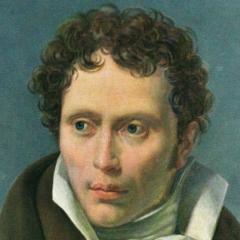
Arthur Schopenhauer
Arthur Schopenhauer

Arthur Schopenhauer was a prominent German philosopher born on February 22, 1788, and died on September 21, 1860. He is one of the most important figures in 19th-century German philosophy and is known for his unique pessimistic philosophical ideas. more

You May Also Like

“In this world, there is no absolute good, no absolute evil," the man said. "Good and evil are not fixed, stable entities but are continually trading places. A good may be transformed into an evil in the next second. And vice versa. Such was teh way of the world that Dostoevksy depicted in The Brothers Karamazov. The most important thing is to maintain the balance between the constantly moving good and evil. If you lean too much in either direction, it becomes difficult to maintain actual morals. Indeed, balance itself is the good.”

“The criminals who, in the face of contumely, hatred or violence, have led the world to a higher standard and brought humanity to a diviner order, have so loved truth and righteousness as to defy the law, and in every age these men have met the life of outcasts, and the death of felons. Whatever may be said of the necessity of government to protect itself, no one can believe that any human being merits punishment for following his own highest ideal. Punishment can only be in any wise defended upon the theory that the individual is untrue to himself, that his heart is bad. But all schemes of human punishment seem specially contrived to exempt this class of men. Those who are untrue to themselves find no difficulty in obeying the state, or at least in seeming to be subservient to its laws. The cunning man without strong convictions of right and wrong can always find ample room to operate his trade inside the dead line the law lays down. Even Blackstone wrote that a man who governed his conduct solely by the law was neither an honest man nor a good citizen. The penal code cannot pretend to cover all the vicious acts of men. If there is a distinction between vicious acts and righteous acts, each are so numerous that even to catalogue them would be beyond the power of the state.”

“Grant Allen once said that an Englishman's idea of God was another Englishman twelve feet high, and I suppose that is more or less everybody's idea of God- with the necessary geographical adjustment. Zenith Brown has an idea about God that pleases me. 'God,' says Mrs. Brown, 'is obviously a friendly enough Old Gentleman most of the time, Who wishes us well and tries to see to it that we are reasonably happy. It is equally obvious the He has an idiot brother who takes over the reins whenever God Himself goes fishing. It is when the idiot brother is in charge of things that the world goes wrong and we have wars, famines, and pestilences on earth.”