Quotessence
Home / Quotes / Quote by Samuel Johnson

Quote by Samuel Johnson

“The fountain of content must spring up in the mind, and he who hath so little knowledge of human nature as to seek happiness by changing anything but his own disposition, will waste his life in fruitless efforts and multiply the grief he proposes to remove.”

Quote by Samuel Johnson

Author
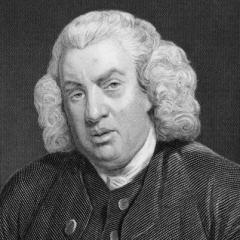
Samuel Johnson
Samuel Johnson

Samuel Johnson was an English writer, poet, and lexicographer, renowned for his comprehensive English dictionary, 'A Dictionary of the English Language', published in 1755. His distinctive writing style and wit have cemented his place as a significant figure in the history of English literature. more

You May Also Like

“Regarding the need to pray, the anarch is again no different from anyone else. But he does not like to attach himself. He does not squander his best energies. He accepts no substitute for his gold. He knows his freedom, and also what it is worth its weight in. The equation balances when he is offered something credible. The result is ONE. There can be no doubt that gods have appeared, not only in ancient times but even late in history; they feasted with us and fought at our sides. But what good is the splendor of bygone banquets to a starving man? What good is the clinking of gold that a poor man hears through the wall of time? The gods must be called. The anarch lets all this be; he can bide his time. He has his ethos, but not morals. He recognizes lawfulness, but not the law; he despises rules. Whenever ethos goes into shalts and shalt-nots, it is already corrupted. Still, it can harmonize with them, depending on location and circumstances, briefly or at length, just as I harmonize here with the tyrant for as long as I like. One error of the anarchists is their belief that human nature is intrinsically good. They thereby castrate society, just as the theologians ("God is goodness") castrate the Good Lord.”

“I believe that there is one story in the world, and only one, that has frightened and inspired us, so that we live in a Pearl White serial of continuing thought and wonder. Humans are caught—in their lives, in their thoughts, in their hungers and ambitions, in their avarice and cruelty, and in their kindness and generosity too—in a net of good and evil. I think this is the only story we have and that it occurs on all levels of feeling and intelligence. Virtue and vice were warp and woof of our first consciousness, and they will be the fabric of our last, and this despite any changes we may impose on field and river and mountain, on economy and manners. There is no other story. A man, after he has brushed off the dust and chips of his life, will have left only the hard, clean questions: Was it good or was it evil? Have I done well—or ill? [...] In uncertainty I am certain that underneath their topmost layers of frailty men want to be good and want to be loved. Indeed, most of their vices are attempted short cuts to love. When a man comes to die, no matter what his talents and influence and genius, if he dies unloved his life must be a failure to him and his dying a cold horror. It seems to me that if you or I must choose between two courses of thought or action, we should remember our dying and try so to live that our death brings no pleasure to the world. We have only one story. All novels, all poetry, are built on the never-ending contest in ourselves of good and evil. And it occurs to me that evil must constantly respawn, while good, while virtue, is immortal. Vice has always a new fresh young face, while virtue is venerable as nothing else in the world is.”

“To do what you imply would require nothing short of divine intervention. you must change man, not systems. Can you and our vapouring friends of the Literary Chamber of Rennes, or any other learned society of France, devise a system of government that has never yet been tried? Surely not. And can we say of any system tried that it proved other than failure in the end? My dear Philippe, the future is to be read with certainty only in the past. Ad actu ad posse valet consecutio. Man never changes. He is always greedy, always acquisitive, always vile. I am speaking of Man in the bulk.”

“For all their simplicity, humans could be remarkably perceptive, though they didn't know it most of the time, and their ability to thrust straight through deception and see to the heart of truth was often lost with childhood. By adulthood humans had trained themselves to be coy and manipulative in response to the coy and manipulative society in which they lived, which led them to believe that everyone was trying to be as coy and manipulative as themselves and were uncertain about what was true and what was not. Beyond their few flashes of clarity, everything became a muddle of colliding doubts.”