Quotessence
Home / Quotes / Quote by Sun Tzu

Quote by Sun Tzu

“Bravery without forethought, causes a man to fight blindly and desperately like a mad bull.  Such an opponent, must not be encountered with brute force, but may be lured into an ambush and slain.”

Quote by Sun Tzu

Work

The Art of War

This seminal work explores the principles of warfare, leadership, and conflict resolution, offering timeless insights into the nature of power and the art of winning battles without resorting to brute force. more
Author

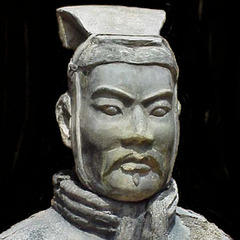
Sun Tzu
Sun Tzu

Sun Tzu, born around 544 BC and died around 496 BC, was a renowned Chinese military strategist. His military thoughts are mainly reflected in his book 'The Art of War', which is considered the classic of military strategy and has had a profound impact on various fields such as military, politics, and economics in later generations. more

You May Also Like

“At the edge of the field Silva and Stefan witnessed heartrending images in greyscale as thousands of desperate refugees streamed down the road in leaden shades of melancholy.  This somber line of tired and dirty humans moved so close together that they jostled each other with each step; their random movements reminded Silva of corks bobbing in a slow moving stream.  They watched them pass from the side of the road, but eventually fell-in, trudging along with the suffering others, feeling safer in numbers, hoping for a destination worth finding.”

“To generalize about war is like generalizing about peace. Almost everything is true. Almost nothing is true. At its core, perhaps, war is just another name for death, and yet any soldier will tell you, if he tells the truth, that proximity to death brings with it a corresponding proximity to life. After a firefight, there is always the immense pleasure of aliveness. The trees are alive. The grass, the soil—everything. All around you things are purely living, and you among them, and the aliveness makes you tremble. You feel an intense, out-of-the-skin awareness of your living self—your truest self, the human being you want to be and then become by the force of wanting it. In the midst of evil you want to be a good man. You want decency. You want justice and courtesy and human concord, things you never knew you wanted. There is a kind of largeness to it, a kind of godliness. Though it’s odd, you’re never more alive than when you’re almost dead. You recognize what’s valuable. Freshly, as if for the first time, you love what’s best in yourself and in the world, all that might be lost. At the hour of dusk you sit at your foxhole and look out on a wide river turning pinkish red, and at the mountains beyond, and although in the morning you must cross the river and go into the mountains and do terrible things and maybe die, even so, you find yourself studying the fine colors on the river, you feel wonder and awe at the setting of the sun, and you are filled with a hard, aching love for how the world could be and always should be, but now is not.”

“When Booker first started working for her a few years ago and was living in their home, she saw him cower with apprehension every time she snapped a new order or made him redo tasks more than once, twice, or three times. Now, she knew that he understood her ways better, her need for order, cleanliness, and strict attention to details. She felt he was beginning to realize just what this fifty-seven-year-old Yankee schoolteacher expected of her thirteen-year-old house servant and pupil. He began to appreciate the books from which she taught him after his morning chores were completed. She gave him a few to start his own library and found he stored them in old dry goods boxes in his bedroom.”