Quotessence
Home / Quotes / Quote by Thomas Mann

Quote by Thomas Mann

Author

Thomas Mann
Thomas Mann

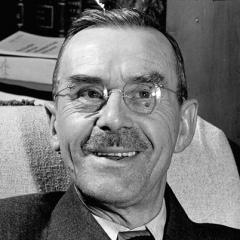
Thomas Mann, born on June 6, 1875, and died on August 12, 1955, was a German novelist and one of the greatest writers of the 20th century. Known for his profound psychological portrayals and rich imagination, his works extensively covered themes such as individual and society, history and reality. His masterpieces include 'Buddenbrooks' and 'The Magic Mountain'. more

You May Also Like

“Holden... One short, faintly stuffy, pedagogical question. Don't you think there's a time and place for everything? Don't you think if someone starts out to tell you about his father's farm, he should stick to his guns, then get around to telling you about his uncle's brace? Or, if his uncle's brace is such a provocative subject, shouldn't he have selected it in the first place as his subject—not the farm?' I didn't feel much like thinking and answering and all. I had a headache and I felt lousy. I even had sort of a stomach-ache, if you want to know the truth. 'Yes—I don't know. I guess he should. I mean I guess he should've picked his uncle as a subject, instead of the farm, if that interested him most. But what I mean is, lots of time you don't know what interests you most till you start talking about something that doesn't interest you most. I mean you can't help it sometimes. What I think is, you're supposed to leave somebody alone if he's at least being interesting and he's getting all excited about something. I like it when somebody gets excited about something. It's nice. You just didn't know this teacher, Mr. Vinson. He could drive you crazy sometimes, him and the goddam class. I mean he'd keep telling you to unify and simplify all the time. Some things you just can't do that to. I mean you can't hardly ever simplify and unify something just because somebody wants you to.”

“If we could see our lives from God's perspective, many of us would be forced to admit that our lives are cluttered with all sorts of things that keep us from moving forward and receiving the abundant life he promises. We need to simplify our lives, eliminating the things that bog us down and keep us from doing what God says are priorities.”

“After all, what justification is there for a word which is simply the opposite of some other word? A word contains its opposite in itself. Take ‘good’, for instance. If you have a word like ‘good’, what need is there for a word like ‘bad’? ‘Ungood’ will do just as well—better, because it’s an exact opposite, which the other is not. Or again, if you want a stronger version of ‘good’, what sense is there in having a whole string of vague useless words like ‘excellent’ and ‘splendid’ and all the rest of them? ‘Plusgood’ covers the meaning, or ‘doubleplusgood’ if you want something stronger still" (51).”

“Nothing is more complex than simplification; what art takes from enigma it more than replenishes in the instantiation of itself, in the labyrinthine puzzle it plants in history. The intensification of enigma. The luxuriantly problematic loam of existence is built out of the sedimented aeons of residues deposited by the will to power, the impulse to create.”