Quotessence
Home / Quotes / Quote by Jean Lorrain

Quote by Jean Lorrain

“Then Chameroy spoke. 'You always put the blame on opium, but as I see it the case of Freneuse is much more complicated. Him, an invalid? No - a character from the tales of Hoffmann! Have you never taken the trouble to look at him carefully? That pallor of decay; the twitching of his bony hands, more Japanese than chrysanthemums; the arabesque profile; that vampiric emaciation - has all of that never given you cause to reflect? In spite of his supple body and his callow face Freneuse is a hundred thousand years old. That man has lived before, in ancient times under the reigns of Heliogabalus, Alexander IV and the last of the Valois. What am I saying? That man is Henri III himself. I have in my library an edition of Ronsard - a rare edition, bound in pigskin with metal trimmings - which contains a portrait of Henri engraved on vellum. One of these nights I will bring the volume here to show you, and you may judge for yourselves. Apart from the ruff, the doublet and the earrings, you would believe that you were looking at the Due de Freneuse. As far as I'm concerned, his presence here inevitably makes me ill - and so long as he is present, there is such an oppression, such a heaviness...”

Quote by Jean Lorrain

Work

Monsieur de Phocas

Monsieur de Phocas is a fictional character at the center of a narrative that intertwines elements of mystery and intrigue. The story unfolds against the backdrop of a tumultuous period, with the protagonist navigating complex social and political landscapes. more

Author
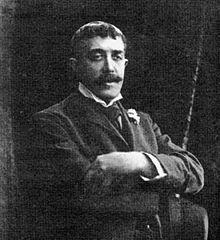
Jean Lorrain
Jean Lorrain

Jean Lorrain, a French poet, is renowned for his unique style and profound emotional expression. His works often delve into themes of love, death, and art, and he is considered one of the representatives of Symbolist literature. more

You May Also Like

“It was Stevenson, I think, who most notably that there are some places that simply demand a story should be told of them. ... After all, perhaps Stevenson had only half of the matter. It is true there are places which stir the mind to think that a story must be told about them. But there are also, I believe, places which have their story stored already, and want to tell this to us, through whatever powers they can; through our legends and lore, through our rumors, and our rites. By its whispering fields and its murmuring waters, by the wailing of its winds and the groaning of its stones, by what it chants in darkness and the songs it sings in light, each place must reach out to us, to tell us, tell us what it holds. ("The Axholme Toll")”

“The rest I omit, for many a bitter Pill can be swallowed under a golden Cover: I make no Mencion that in each of my Churches I put a Signe so that he who sees the Fabrick may see also the Shaddowe of the Reality of which it is the Pattern or Figure. Thus, in the church of Lime-house, the nineteen Pillars in the Aisles will represent the Names of Baal-Berith, the seven Pillars of the Chappell will signify the Chapters of his Covenant. All those who wish to know more of this may take up Clavis Salomonis, Niceron's Thaumaturgus Opticus where he speaks of Line and Distance, Cornelius Agrippa his De occuItia philosophia and Giordano Bruno his De magia and De vinculis in genere where he speaks of Hieroglyphs and the Raising of the Devilles.”

“The Ridyadh Bodkin and the Kuala Lumpur Mushroom are positive Meccas for all kinds of daredevils-of this much I'm sure. Decadent Saudi princes pilot microlights through huge holes in their facades, while Malaysian spider men scale them using giant suckers in lieu of crampons. All these activities serve to demonstrate is that modernist megaliths have completely suborned the role of natural features in providing us with the essential and vertiginous perspective we require to comprehend accurately our ant-like status.”

“An age-old city is like a pond. With its colours and reflections. Its chills and murk. Its ferment, its sorcery, its hidden life. A city is like a woman, with a woman’s desires and dislikes. Her abandon and restraint. Her reserve - above all, her reserve. To get to the heart of a city, to learn its most subtle secrets, takes infinite tenderness, and patience sometimes to the point of despair. It calls for an artlessly delicate touch, a more or less unconditional love. Over centuries. Time works for those who place themselves beyond time. You’re no true Parisian, you do not know your city, if you haven’t experienced its ghosts. To become imbued with shades of grey, to blend into the drab obscurity of blind spots, to join the clammy crowd that emerges, or seeps, at certain times of day from the metros, railway stations, cinemas or churches, to feel a silent and distant brotherhood with the lonely wanderer, the dreamer in his shy solitude, the crank, the beggar, even the drunk - all this entails a long and difficult apprenticeship, a knowledge of people and places that only years of patient observation can confer.”

“He insisted on clearing the table, and again devoted himself to his game of patience: piecing together the map of Paris, the bits of which he’d stuffed into the pocket of his raincoat, folded up any old how. I helped him. Then he asked me, straight out, ‘What would you say was the true centre of Paris?’ I was taken aback, wrong-footed. I thought this knowledge was part of a whole body of very rarefied and secret lore. Playing for time, I said, ‘The starting point of France’s roads . . . the brass plate on the parvis of Notre-Dame.’ He gave me a withering look. ‘Do you take for me a sap?’ The centre of Paris, a spiral with four centres, each completely self-contained, independent of the other three. But you don’t reveal this to just anybody. I suppose - I hope - it was in complete good faith that Alexandre Arnoux mentioned the lamp behind the apse of St-Germain-l’Auxerrois. I wouldn’t have created that precedent. My turn now to let the children play with the lock. ‘The centre, as you must be thinking of it, is the well of St-Julien-le-Pauvre. The “Well of Truth” as it’s been known since the eleventh century.’ He was delighted. I’d delivered. He said, ‘You know, you and I could do great things together. It’s a pity I’m already “beyond redemption”, even at this very moment.’ His unhibited display of brotherly affection was of childlike spontaneity. But he was still pursuing his line of thought: he dashed out to the nearby stationery shop and came back with a little basic pair of compasses made of tin. ‘Look. The Vieux-Chene, the Well. The Well, the Arbre-a-Liege On either side of the Seine, adhering closely to the line he’d drawn, the age-old tavern signs were at pretty much the same distance from the magic well. ‘Well, now, you see, it’s always been the case that whenever something bad happens at the Vieux-Chene, a month later — a lunar month, that is, just twenty-eight days — the same thing happens at old La Frite’s place, but less serious. A kind of repeat performance. An echo Then he listed, and pointed out on the map, the most notable of those key sites whose power he or his friends had experienced. In conclusion he said, ‘I’m the biggest swindler there is, I’m prepared to be swindled myself, that’s fair enough. But not just anywhere. There are places where, if you lie, or think ill, it’s Paris you disrespect. And that upsets me. That’s when I lose my cool: I hit back. It’s as if that’s what I was there for.”

“But this is something you need to know: when you find a place that suits you, where you decide to go back to often, to meet your pals there, if you want to feel at home and not discover some snag at the wrong moment, sit yourself in a corner, write letters, read, try and eat there, and watch what goes on for a whole day. At least twice during the day, and three times if the place is open at night, there’s that moment of “temporal void”. It happens every day, at the very same hour, at the very same minute, but it varies from place to place. People are talking, letting their hair down, having a drink together, and all of a sudden, the moment of silence: everyone turns stock still, with their glasses in the air, their eyes fixed. Immediately afterwards the hubbub resumes. But that moment when nothing’s happening - it can last five, ten minutes. And during that time, outside and everywhere else, for other people life goes on, faster, much faster, like an avalanche. If you’re prepared for it, and take advantage of that moment not to be fazed and to have your say, you’re certain to be heard, and if necessary even obeyed. Try it. You’ll see.”