Quotessence
Home / Quotes / Quote by Stephen Hawking

Quote by Stephen Hawking

“People have always wanted answers to the big questions. Where did we come from? How did the universe begin? What is the meaning and design behind it all? Is there anyone out there? The creation accounts of the past now seem less relevant and credible. They have been replaced by a variety of what can only be called superstitions, ranging from New Age to Star Trek. But real science can be far stranger than science fiction, and much more satisfying. I am a scientist. And a scientist with a deep fascination with physics, cosmology, the universe and the future of humanity. I was brought up by my parents to have an unwavering curiosity and, like my father, to research and try to answer the many questions that science asks us. I have spent my life travelling across the universe, inside my mind. Through theoretical physics, I have sought to answer some of the great questions. At one point, I thought I would see the end of physics as we know it, but now I think the wonder of discovery will continue long after I am gone. We are close to some of these answers, but we are not there yet.”

Quote by Stephen Hawking

Work

Brief Answers to the Big Questions

Browse quotes and source details for this work. more

Author
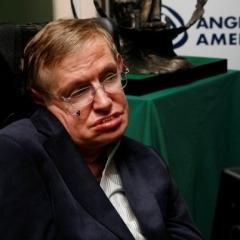
Stephen Hawking
Stephen Hawking

Stephen Hawking was a renowned British theoretical physicist known for his contributions to the fields of black hole theory and cosmology. Born on January 8, 1942, he overcame the challenges of ALS to become a global icon of science and perseverance. more

You May Also Like

“The big question in cosmology in the early 1960s was did the universe have a beginning? Many scientists were instinctively opposed to the idea, because they felt that a point of creation would be a place where science broke down. One would have to appeal to religion and the hand of God to determine how the universe would start off. This was clearly a fundamental question, and it was just what I needed to complete my PhD thesis. Roger Penrose had shown that once a dying star had contracted to a certain radius, there would inevitably be a singularity, that is a point where space and time came to an end. Surely, I thought, we already knew that nothing could prevent a massive cold star from collapsing under its own gravity until it reached a singularity of infinite density. I realised that similar arguments could be applied to the expansion of the universe. In this case, I could prove there were singularities where space–time had a beginning. A eureka moment came in 1970, a few days after the birth of my daughter, Lucy. While getting into bed one evening, which my disability made a slow process, I realised that I could apply to black holes the casual structure theory I had developed for singularity theorems. If general relativity is correct and the energy density is positive, the surface area of the event horizon—the boundary of a black hole—has the property that it always increases when additional matter or radiation falls into it. Moreover, if two black holes collide and merge to form a single black hole, the area of the event horizon around the resulting black hole is greater than the sum of the areas of the event horizons around the original black holes.”

“I have led an extraordinary life on this planet, while at the same time travelling across the universe by using my mind and the laws of physics. I have been to the furthest reaches of our galaxy, travelled into a black hole and gone back to the beginning of time. On Earth, I have experienced highs and lows, turbulence and peace, success and suffering. I have been rich and poor, I have been able-bodied and disabled. I have been praised and criticised, but never ignored. I have been enormously privileged, through my work, in being able to contribute to our understanding of the universe. But it would be an empty universe indeed if it were not for the people I love, and who love me. Without them, the wonder of it all would be lost on me. And at the end of all this, the fact that we humans, who are ourselves mere collections of fundamental particles of nature, have been able to come to an understanding of the laws governing us, and our universe, is a great triumph. I want to share my excitement about these big questions and my enthusiasm about this quest.”

“At the moment of the Big Bang, an entire universe came into existence, and with it space. It all inflated, just like a balloon being blown up. So where did all this energy and space come from? How does an entire universe full of energy, the awesome vastness of space and everything in it, simply appear out of nothing? For some, this is where God comes back into the picture. It was God who created the energy and space. The Big Bang was the moment of creation. But science tells a different story. At the risk of getting myself into trouble, I think we can understand much more the natural phenomena that terrified the Vikings. We can even go beyond the beautiful symmetry of energy and matter discovered by Einstein. We can use the laws of nature to address the very origins of the universe, and discover if the existence of God is the only way to explain it.”

“We’re at a point in time where we have the resources and tools available to us to break the chains of our karmic patterning. We’re in fact creating new possibilities; the universe, source, doesn’t create the same thing verbatim twice, even if it looks the same on the surface the internal makeup, the DNA, the experience is unique.”

“All the universe has got a sex-like quality about it. It is seminal and productive at the same time. The seeds of words produce ideas. The seeds of ideas produce goodness knows what. The whole blessed thing is male and female at one and the same time. In fact, the whole thing is pure sex. We’ve taken one aspect of it and called it sex, or made it self-conscious and called it Sex. But that was our own fault, wasn’t it? – Fynn, Mister God, This is Anna”