Quotessence
Home / Quotes / Quote by Ursula K. Le Guin

Quote by Ursula K. Le Guin

“Ged saw all these things from outside and apart, alone, and his heart was very heavy in him, though he would not admit to himself that he was sad. As night fell he still lingered in the streets, reluctant to go back to the inn. He heard a man and a girl talking together merrily as they came down the street past him towards the town square, and all at once he turned, for he knew the man's voice. He followed and caught up with the pair, coming up beside them in the late twilight lit only by distant lantern-gleams. The girl stepped back, but the man stared at him and then flung up the staff he carried, holding it between them as a barrier to ward off the threat or act of evil. And that was somewhat more than Ged could bear. His voice shook a little as he said, "I thought you would know me, Vetch." Even then Vetch hesitated for a moment. "I do know you," he said, and lowered the staff and took Ged's hand and hugged him round the shoulders-" I do know you! Welcome, my friend, welcome! What a sorry greeting I gave you, as if you were a ghost coming up from behind– and I have waited for you to come, and looked for you-”

Quote by Ursula K. Le Guin

Work

A Wizard of Earthsea

Le Guin's novel is renowned for its intricate world-building and philosophical themes, following Ged as he learns the responsibilities and consequences of his magical powers. more

Author
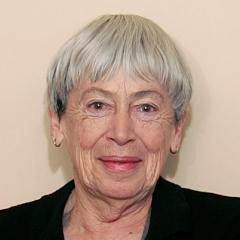
Ursula K. Le Guin
Ursula K. Le Guin

Ursula K. Le Guin, born on October 21, 1929, is an esteemed American author of science fiction and fantasy. Known for her profound philosophical insights, rich imagination, and unique narrative style, Le Guin's works have won numerous literary awards and have had a significant impact on science fiction and fantasy literature. Her most famous works include the 'Earthsea' series and 'The Left Hand of Darkness', which have won her awards such as the Nebula and Hugo Awards, and she has also received the National Book Award for lifetime achievement for her contributions to literature. more

You May Also Like

“One of the reasons that hiddenness is such an important aspect of the spiritual life is that it keeps us focused on God. In hiddenness we do not receive human acclamation, admiration, support, or encouragement. In hiddenness we have to go to God with our sorrows and joys and trust that God will give us what we most need. In our society we are inclined to avoid hiddenness. We want to be seen and acknowledged. We want to be useful to others and influence the course of events. But as we become visible and popular, we quickly grow dependent on people and their responses and easily lose touch with God, the true source of our being. Hiddenness is the place of purification. In hiddenness we find our true selves.”

“Was I (am I not still?) a victim of words and books merely, and are books just an excuse for living, living things out in parenthesis, even in the most desolate stony place as I was, quotations and misquotations raining down on me thick and fast – words, words, words – the multitude of words, a parody of rain? For after all, as old Mrs Feany said, the rain is healthy. And the rain it raineth everyday. But the stuff of books and solitude and spying on the poor, could they be healthy? Or were my doubts the real heresy and treason? What book ever changed the world? It seems a solipsism to say that what changes the way we see the world, changes the world, but it is not. Where do you want me to begin? The Bible, Das Kapital? The Divine Comedy, The Satanic Verses?”

“The earth is grounding while the mountains, curvaceous and sweeping, offer a blanket of refuge. Their woods are abounding in camouflage as their leaves sway about in continuous, florid dance. There is an air of invulnerability that is exclusive to the woods, which is why she’s most happy among them. She doesn’t mind beasts as they are preferable to humans and much less threatening; beasts, you see, although dangerous, are incapable of the enmity that permeates beyond the shade of the woods.”

“Who are we without our addictions; without our media-induced hungers? So often the voices we hear echoing in our mind are not our own but that of our influencers. Isolation, while arguably going against human nature, is essential for mental and emotional health. Solitude is a detoxification of all that distorts our personality and misguides our path in life. It allows us to filter out the foreign opinions and hear our own voice—reach our authentic character—and practice fidelity to self.”