Quotessence
Home / Quotes / Quote by Alexandre Dumas

Quote by Alexandre Dumas

“Joyful friends, mostly loyal, they hadn't abandoned their protector before the gathering storm; and despite the threatening sky, despite the shuddering earth, they remained, smiling, considerate, and as devoted to misfortune as they had been to prosperity.”

Quote by Alexandre Dumas

Work

The Man in the Iron Mask

This novel delves into the intrigue and mystery surrounding a man who is imprisoned in an iron mask and kept in isolation. The story is set in the 17th century France and explores themes of power, betrayal, and the human condition. more

Author
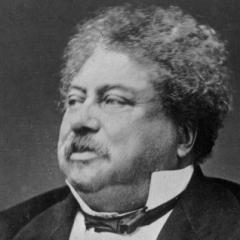
Alexandre Dumas
Alexandre Dumas

Alexandre Dumas, a renowned French writer, was born on July 24, 1802, and died on December 5, 1870. He is famous for his historical and adventure novels, with notable works including 'The Three Musketeers' and 'The Count of Monte Cristo'. more

You May Also Like

“Once a person falls in the fields of love, all the rules are already broken; the lover becomes open an exalted in ways that transcend the local issues as well as the commonly held beliefs. Love, like genuine devotion, will find a way. Where duty becomes replaced with love, a greater and deeper faith will blossom forth.”

“Sergeant Pietro Oliva was a good Catholic. He liked to go into a church and cross himself, genuflect to the alter, and then settle down to a little prayer and contemplation, savouring the coolness, the heavy odours, the darkness, and the sensation of being soaked in the atmosphere of centuries’ worth of devotion that hung in the tenebrous and golden air of churches.”

“Phædrus wrote a letter from India about a pilgrimage to holy Mount Kailas, the source of the Ganges and the abode of Shiva, high in the Himalayas, in the company of a holy man and his adherents. He never reached the mountain. After the third day he gave up, exhausted, and the pilgrimage went on without him. He said he had the physical strength but that physical strength wasn’t enough. He had the intellectual motivation but that wasn’t enough either. He didn’t think he had been arrogant but thought that he was undertaking the pilgrimage to broaden his experience, to gain understanding for himself. He was trying to use the mountain for his own purposes and the pilgrimage too. He regarded himself as the fixed entity, not the pilgrimage or the mountain, and thus wasn’t ready for it. He speculated that the other pilgrims, the ones who reached the mountain, probably sensed the holiness of the mountain so intensely that each footstep was an act of devotion, an act of submission to this holiness. The holiness of the mountain infused into their own spirits enabled them to endure far more than anything he, with his greater physical strength, could take.”