Quotessence
Home / Quotes / Quote by Samuel Johnson

Quote by Samuel Johnson

“There are men who always confound the praise of goodness with the practice, and who believe themselves mild and moderate, charitable and faithful, because they have exerted their eloquence in commendation of mildness, fidelity, and other virtues.”

Quote by Samuel Johnson

Work

The Rambler

The Rambler is a collection of periodical essays written by Samuel Johnson, published twice weekly between 1750 and 1752. The essays cover a wide range of topics, including ethics, philosophy, literary criticism, and observations on daily life, often presented through fictional characters and allegorical narratives. Johnson's prose is characterized by its moral seriousness, rhetorical elegance, and deep psychological insight, aiming to instruct and improve readers while addressing universal human concerns such as ambition, vanity, and the pursuit of happiness. The work is considered a landmark in English essay writing and a key example of 18th-century moral literature. more
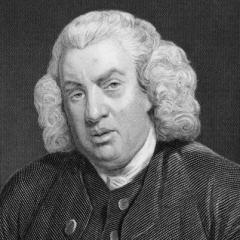
Author

Samuel Johnson
Samuel Johnson

Samuel Johnson was an English writer, poet, and lexicographer, renowned for his comprehensive English dictionary, 'A Dictionary of the English Language', published in 1755. His distinctive writing style and wit have cemented his place as a significant figure in the history of English literature. more

You May Also Like

“The times grow less dark for all the races, because within the culture, too, is memory, and understanding of what works and what does not. when those lessons are forgotten, the circle winds its way backward, and when they are remembered, society moves forward, and with each cycle, with each affirmation that which is good and that which is evil, the starting point of the next lesson is a bit closer to goodness. It is a long roll, this circle, but it is rolling in the direction of justice and goodness, for all of us. It is not hard to look back on history and see atrocities committed on a grand scale that horrify the sensibilities of the folk of this day but where simply accepted or deemed necessary by folk in days more superstitious and unenlightened”