Quotessence
Home / Quotes / Quote by Sophocles

Quote by Sophocles

Work

Antigone

This renowned work explores themes of justice, morality, and the conflict between individual conscience and the state. It tells the story of Antigone, who defies the king's decree and buries her brother, leading to a series of tragic events. more

Author

Sophocles
Sophocles

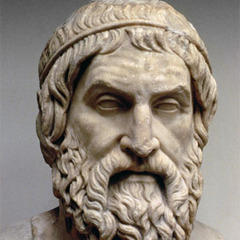
Sophocles, born in 498 BC and died in 406 BC, was a renowned Greek tragic playwright. He is one of the three greatest tragic poets of ancient Greece, alongside Aeschylus and Euripides. Sophocles' works profoundly revealed the complexity of human nature and social contradictions, exerting a profound influence on subsequent drama. more

You May Also Like

“What a woman you are,” he murmured, and she heard the emotion in it, the way the Irish thickened just a bit in his voice. And saw it in those vivid eyes when he drew back. “That you would think of this. That you would do this.” He shook his head, kissed her. Like the breath, long and quiet. “I can’t thank you enough. There isn’t enough thanks. I can’t say what this means to me, even to you. I don’t have the words for it.” He took her hands, brought them both to his lips. “A ghra. You stagger me.” He framed her face now, touched his lips to her brow. “You’re the beat of my heart, the breath in my body, the light in my soul.”

“I am a lonely man," he said again that evening. "And is it not possible that you are also a lonely person? But I am an older man, and I can live with my loneliness, quietly. You are young, and it must be difficult to accept your loneliness. You must sometimes want to fight it." "But I am not at all lonely." "Youth is the loneliest time of all. Otherwise, why should you come so often to my house?" Sensei continued: "But surely, when you are with me, you cannot rid yourself of your loneliness. I have not it in me to help you forget it. You will have to look elsewhere for the consolation you seek. And soon, you will find that you no longer want to visit me." As he said this, Sensei smiled sadly.”

“Today the individual has become the highest form, and the greatest bane, of artistic creation. The smallest wound or pain of the ego is examined under a microscope as if it were of eternal importance. The artist considers his isolation, his subjectivity, his individualism almost holy. Thus we finally gather in one large pen, where we stand and bleat about our loneliness without listening to each other and without realizing that we are smothering each other to death. The individualists stare into each other's eyes and yet deny each other's existence. We walk in circles, so limited by our own anxieties that we can no longer distinguish between true and false, between the gangster's whim and the purest ideal.”