Quotessence
Home / Quotes / Quote by Aleksandr Solzhenitsyn

Quote by Aleksandr Solzhenitsyn

“Oh, without the brigade one could still somehow manage to survive the camp! Without the brigade you are an individual, you yourself choose your own line of conduct. Without the brigade you can at least die proudly, but in the brigade the only way they allow you even to die is in humiliation, on your belly. From the chief, from the camp foreman, from the jailer, from the convoy guard, from all of them you can hide and catch a moment of rest; you can ease up a bit here on hauling, shirk a bit there on lifting. But from the driving belts, from your comrades in the brigade, there is neither a hiding place, nor salvation, nor mercy. You cannot not want to work. You cannot, conscious of being a political [prisoner], prefer death from hunger to work. No! Once you have been marched outside the compound, once you have been registered as going out to work, everything the brigade does today will be divided not by twenty-five but by twenty-six, and because of you the entire brigade's percentage of norm will fall from 123 to 119, which makes the difference between the ration allotted to record breakers and ordinary rations, and everyone will lose a millet cake and three and a half ounces of bread. And that is why your comrades keep watch on you better than any jailers! And the brigade leader's fist will punish you far more effectively than the whole People's Commissariat of Internal Affairs. Now that is what spontaneous initiative in re-education means! That is psychological enrichment of the personality by the collective!”

Quote by Aleksandr Solzhenitsyn

Work

Author

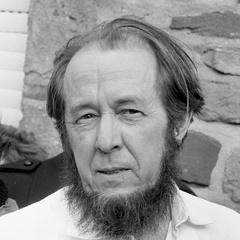
Aleksandr Solzhenitsyn

Aleksandr Solzhenitsyn, a Russian novelist, was born on December 11, 1918, and died on August 3, 2008. He is renowned for his works that profoundly exposed the dark side of the Soviet political system and is considered one of the greatest writers of the 20th century. more

You May Also Like

“Satanism, in principle, is a perverse projection of the Law into matter. Therefore, even this path has its aesthetic elements. For there are also artists of evil, artists who can give flowing blood the magic of a crimson evening afterglow—adepts of delusion, who with a mere sight, evoke the seductive song of Death and loathsome orgies turn into a wild cascade of ardent memories.”

“The first thought of writing this book came to me two years ago after I had driven through the mining district of Lanarkshire. The journey took me through Hamilton, Airdrie and Motherwell. It was a warm, overcast summer day; groups of idle, sullen-looking young men stood at the street corners; smaller groups were wandering among the blue-black ranges of pit-dumps which in that region are the substitute for nature; the houses looked empty and unemployed like the tenants; and the road along which the car stumbled was pitted and rent, as if it had recently been under shell-fire. Everything had the look of a Sunday which had lasted for many years, during which the bells had forgotten to ring - a disused, slovenly everlasting Sunday.”

“It is quite natural to think of the self as something concrete, but it is, in fact, nothing of the sort. Rather, it is an abstract product of our minds, a convenient concept or schema that enables us to relate our present self with our past, future, and conditional selves, and thereby to create an illusion of coherence and continuity from a big jumble of disparate experiences. Indeed, one could go so far as to argue that the self is nothing but the sum total of our ego defences, and that it is therefore tantamount to one gigantic ego defence, namely, the ego itself. The self is like a cracked mask that is in constant need of being pieced together. But behind the mask there is nobody at home.”

“What is human memory?" Manning asked. He gazed at the air as he spoke, as if lecturing an invisible audience - as perhaps he was. "It certainly is not a passive recording mechanism, like a digital disc or a tape. It is more like a story-telling machine. Sensory information is broken down into shards of perception, which are broken down again to be stored as memory fragments. And at night, as the body rests, these fragments are brought out from storage, reassembled and replayed. Each run-through etches them deeper into the brain's neural structure. And each time a memory is rehearsed or recalled it is elaborated. We may add a little, lose a little, tinker with the logic, fill in sections that have faded, perhaps even conflate disparate events. "In extreme cases, we refer to this as confabulation. The brain creates and recreates the past, producing, in the end, a version of events that may bear little resemblance to what actually occurred. To first order, I believe it's true to say that everything I remember is false.”

“No road map, no manifesto, no vision from the climate movement - and it has its fair share of radicals - ever sketched anything like the meteor storm of state interventions that hit the planet in March 2020, and yet we were always told that we were being unrealistic, unpragmatic, dreamers or alarmists. Never again should such lies be given a hearing.”