Quotessence
Home / Quotes / Quote by Victor Hugo

Quote by Victor Hugo

“They were eyes no longer, but had become those fathomless mirrors which in men who have known the depths of suffering may replace the conscious gaze, so that they no longer see reality but reflect the memory of past events.”

Quote by Victor Hugo

Work

Les Misérables

Victor Hugo's 'Les Misérables' is an epic narrative that delves into the lives of various characters, including Jean Valjean, a former convict seeking redemption, and Fantine, a woman struggling in poverty. The story is rich in historical detail and moral complexity, offering a profound examination of society's flaws and the resilience of the human spirit. more
Author

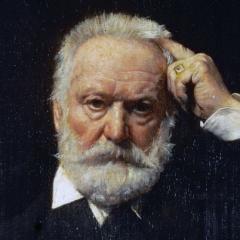
Victor Hugo
Victor Hugo

Victor Hugo, a French romantic poet, novelist, and playwright, was born on February 26, 1802, and died on May 22, 1885. He is considered one of the greatest writers in French literary history, known for his profound humanistic concerns and rich imagination. more

You May Also Like

“It was a glorious night. The moon had sunk, and left the quiet earth alone with the stars. It seemed as if, in the silence and the hush, while we her children slept, they were talking with her, their sister—conversing of mighty mysteries in voices too vast and deep for childish human ears to catch the sound. They awe us, these strange stars, so cold, so clear. We are as children whose small feet have strayed into some dim-lit temple of the god they have been taught to worship but know not; and, standing where the echoing dome spans the long vista of the shadowy light, glance up, half hoping, half afraid to see some awful vision hovering there. And yet it seems so full of comfort and of strength, the night. In its great presence, our small sorrows creep away, ashamed. The day has been so full of fret and care, and our hearts have been so full of evil and of bitter thoughts, and the world has seemed so hard and wrong to us. Then Night, like some great loving mother, gently lays her hand upon our fevered head, and turns our little tear-stained faces up to hers, and smiles; and, though she does not speak, we know what she would say, and lay our hot flushed cheek against her bosom, and the pain is gone. Sometimes, our pain is very deep and real, and we stand before her very silent, because there is no language for our pain, only a moan. Night’s heart is full of pity for us: she cannot ease our aching; she takes our hand in hers, and the little world grows very small and very far away beneath us, and, borne on her dark wings, we pass for a moment into a mightier Presence than her own, and in the wondrous light of that great Presence, all human life lies like a book before us, and we know that Pain and Sorrow are but the angels of God. Only those who have worn the crown of suffering can look upon that wondrous light; and they, when they return, may not speak of it, or tell the mystery they know.”

“But what is particular to America is that many who suffered enormous loss and destruction have had to do so alone, had to marshal language to tell the story, only to find that there was no one to hear it because their suffering contradicts the story that the nation keeps telling itself—the story of American exceptionalism. America is a beacon of light, the singular enforcer of truth. Our story of exceptionalism doesn’t allow us to confront our past with open eyes. A nation that cannot see its own past cannot see the suffering it has caused, suffering that persists into the present.”

“Why, Neph, do they live on? Isn’t it better to be dead, to die quickly and with some honour than to be worked and beaten to death like a beast?” “No,” Neph answered shortly. “I don’t understand. I would die and welcome the dark lord Osiris.” “No, you wouldn’t,” Neph said. “But I tell you I would!” “Ah, yes, you tell me that. When life is full and sweet and young, as it is with a prince of the Great House, then the thought of surrendering it becomes an easy abstraction. You have so much life that you can be prodigal with it, Moses. But when life hangs by a thread, then by all the gods that be, it is nothing you give up easily! Life is the reason for life, as you will some day learn, and reason enough, you may be sure.”

“Once upon a time, through a strange country, there rode some goodly knights, and their path lay by a deep wood, where tangled briars grew very thick and strong, and tore the flesh of them that lost their way therein. And the leaves of the trees that grew in the wood were very dark and thick, so that no ray of light came through the branches to lighten the gloom and sadness. And, as they passed by that dark wood, one knight of those that rode, missing his comrades, wandered far away, and returned to them no more; and they, sorely grieving, rode on without him, mourning him as one dead. Now, when they reached the fair castle towards which they had been journeying, they stayed there many days, and made merry; and one night, as they sat in cheerful ease around the logs that burned in the great hall, and drank a loving measure, there came the comrade they had lost, and greeted them. His clothes were ragged, like a beggar’s, and many sad wounds were on his sweet flesh, but upon his face there shone a great radiance of deep joy. And they questioned him, asking him what had befallen him: and he told them how in the dark wood he had lost his way, and had wandered many days and nights, till, torn and bleeding, he had lain him down to die. Then, when he was nigh unto death, lo! through the savage gloom there came to him a stately maiden, and took him by the hand and led him on through devious paths, unknown to any man, until upon the darkness of the wood there dawned a light such as the light of day was unto but as a little lamp unto the sun; and, in that wondrous light, our way-worn knight saw as in a dream a vision, and so glorious, so fair the vision seemed, that of his bleeding wounds he thought no more, but stood as one entranced, whose joy is deep as is the sea, whereof no man can tell the depth. And the vision faded, and the knight, kneeling upon the ground, thanked the good saint who into that sad wood had strayed his steps, so he had seen the vision that lay there hid. And the name of the dark forest was Sorrow; but of the vision that the good knight saw therein we may not speak nor tell.”