Quotessence
Home / Quotes / Quote by Hermann Hesse

Quote by Hermann Hesse

“For much longer, he could have stayed with Kamaswami, made money, wasted money, filled his stomach, and let his soul die of thirst; for much longer he could have lived in this soft, well upholstered hell, if this had not happened: the moment of complete hopelessness and despair, that most extreme moment, when he hang over the rushing waters and was ready to destroy himself. That he had felt this despair, this deep disgust, and that he had not succumbed to it, that the bird, the joyful source and voice in him was still alive after all, this was why he felt joy, this was why he laughed, this was why his face was smiling brightly under his hair which had turned gray.”

Quote by Hermann Hesse

Work

Siddhartha

Hermann Hesse's 'Siddhartha' is a profound exploration of the human quest for enlightenment and self-discovery. The story follows the life of Siddhartha, a young Brahmin who leaves his family and societal expectations to seek truth and wisdom. His journey takes him through various experiences, including asceticism, wealth, and love, as he grapples with the complexities of life and the nature of reality. more

Author

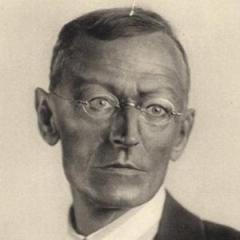
Hermann Hesse
Hermann Hesse

Hermann Hesse was a German poet and novelist, born on July 2, 1877, and died on August 9, 1962. Known for his profound psychological descriptions and exploration of human nature, his works include classics such as 'Steppenwolf' and 'The Glass Bead Game'. more

You May Also Like

“I sometimes doubt whether even the friends whose kind thoughts turned downwards me that evening from the distant South and West could realize how cheerful is the recollection of the Christmas spent in the solitude and cold of the desert.”

“Why are some people’s lives so hard and painful?” “It goes back to the two-sided coin. The opposite sides are needed to complete the lesson. Some lives seem very difficult, and others seem relatively easy, but both pose different lessons. If a person needs to learn self-respect, they might return and have an abusive relationship with a family member who pushes those boundaries. That situation encourages individuals to stand up for themselves and draw healthy boundaries. But if you come back to learn compassion or empathy, living a life of luxury can cause a person to be complacent, and therefore, they might live their whole life without learning their lesson. An easy life might set a person up for a more challenging lesson than a difficult life. They might get so caught up in their life of luxury that they see no reason for soul searching, and as a result, they never learn their lessons. Imagine an individual driving down the road, seeing a repeating sign—LIFE LESSON . . . LIFE LESSON—but they pay it no mind; they just keep driving! Hopefully, they’ll make a U-turn; otherwise, they’ve missed their exit—their opportunity to learn an important lesson.”

“Honestly, it has been an extraordinary journey . . . so extraordinary that some people questioned whether the things I told them were the truth. Then again, people often question things they haven’t experienced, because they have no reference point.”