Quotessence
Home / Quotes / Quote by Karl Marx

Quote by Karl Marx

“The economists tell us, to be sure, that those labourers who have been rendered superfluous by machinery find new avenues of employment, They dare not assert directly that the same labourers that have been discharged find situations in new branches of labour. Facts cry out too loudly against this lie. Strictly speaking, they only maintain that new means of employment will be found for other sections of the working class; for example, for that portion of the young generation of labourers who were about to enter upon that branch of industry which had just been abolished. Of course, this is a great satisfaction to the disabled labourers. There will be no lack of fresh exploitable blood and muscle for the Messrs. Capitalists—the dead may bury their dead. This consolation seems to be intended more for the comfort of the capitalists themselves than of their labourers. If the whole class of the wage-labourer were to be annihilated by machinery, how terrible that would be for capital, which, without wage-labour, ceases to be capital!”

Quote by Karl Marx

Work

Wage-Labour and Capital & Value, Price and Profit

Browse quotes and source details for this work. more

Author
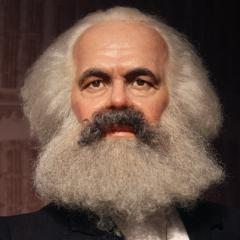
Karl Marx
Karl Marx

Karl Marx (May 5, 1818 - March 14, 1883) was a German philosopher, economist, sociologist, political theorist, and revolutionary. He is one of the founders of Marxism and his works, including 'Das Kapital' and 'The Communist Manifesto', have had a profound impact on the world. more

You May Also Like

“They meant what they said about freedom. They fought a real revolution. They fought so that this could be a country where every man was equal in the sight of Nature - with an equal chance. This didn't mean that twenty per cent of the people were free to rob the other eighty per cent of the means to live. This didn't mean for one rich man to sweat the piss out of ten thousand poor men so that he can get richer. This didn't mean the tyrants were free to get this country in such a fix that millions of people are ready to do anything – cheat, lie, or whack off their right arm – just to work for three squares and a flop. They have made the word freedom a blasphemy. You hear me? They have made the word freedom stink like a skunk to all who know.”

“So what was work? Tasks we performed for compensation in the service of an employer, be it an individual or a corporate entity. And yes, it was as exciting as it sounds. We didn't want to work. In fact, that's about as good a definition of work as you could have: that which we didn't want to do, but had to if we didn't want to eat dirt.”

“They fear that without compulsion the masses will not work. But during our own lifetime, have we not heard the same fears expressed twice? Once, by the anti-abolitionists in America before the emancipation of the Negroes, and, for a second time, by the Russian nobility before the liberation of the serfs? 'Without the whip the Negro will not work,' said the anti- abolitionist. 'Free from their master's supervision the serfs will leave the fields uncultivated,' said the Russian serf-owners. It was the refrain of the French noblemen in 1789, the refrain of the Middle Ages, a refrain as old as the world, and we shall hear it every time there is a question of sweeping away an injustice. And each time actual facts give it the lie. The liberated peasant of 1792 ploughed with an eager energy, unknown to his ancestor so, the emancipated Negro works more than his fathers; and the Russian peasant, after having honoured the honeymoon of his emancipation by celebrating Fridays as well as Sundays, has taken up work with an eagerness proportionate to the completeness of his liberation. There, where the soil is his, he works desperately; that is the exact word for it. The anti-abolitionist refrain can be of value to slave-owners; as to the slaves them- selves, they know what it is worth, as they know its motive.”

“A divided heart can never bring complete satisfaction. The man of mingled interests will seldom make a success of anything. If he would succeed in business he must give the major portion of his time and the best of his thought to his business.... The very same is true of the man who would be used of God, only to a far greater degree. The work alone must claim his whole attention. He has no room for other things.”