Quotessence
Home / Quotes / Quote by Hermann Hesse

Quote by Hermann Hesse

“Welcher Vater, welcher Lehrer hat ihn davor schützen können, selbst das Leben zu leben, selbst sich mit dem Leben zu beschmutzen, selbst Schuld auf sich zu laden, selbst den bitteren Trank zu trinken, selber seinen Weg zu finden? Glaubst du denn, Lieber, dieser Weg bleibe irgend jemandem vielleicht erspart? Vielleicht deinem Söhnchen, weil du es liebst, weil du ihm gern Leid und Schmerz und Enttäuschung ersparen möchtest? Aaber auch wenn du zehnmal für ihn stürbest, würdest du ihm nicht den kleinsten Teil seines Schicksals damit abnehmen können.”

Quote by Hermann Hesse

Work

Siddhartha

Hermann Hesse's 'Siddhartha' is a profound exploration of the human quest for enlightenment and self-discovery. The story follows the life of Siddhartha, a young Brahmin who leaves his family and societal expectations to seek truth and wisdom. His journey takes him through various experiences, including asceticism, wealth, and love, as he grapples with the complexities of life and the nature of reality. more

Author

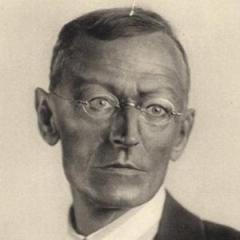
Hermann Hesse
Hermann Hesse

Hermann Hesse was a German poet and novelist, born on July 2, 1877, and died on August 9, 1962. Known for his profound psychological descriptions and exploration of human nature, his works include classics such as 'Steppenwolf' and 'The Glass Bead Game'. more

You May Also Like

“... love and fear can sometimes feel the same, but each will lead a person to take different actions. When a decision h as to be made, fear usually motivates me to choose what is best for me, whereas love motivates me to choose what is best for another person. Fear urges me to hang on, white knuckled, to what is mine, while love can actually lead me to let go.... when you hold something you love tightly to your chest for fear of losing it, you actually risk crushing it against you.”

“Ulis, he prayed, abandoning the set words, let my anger die with him. Let both of us be freed from the burden of his actions. Even if I cannot forgive him, help me not to hate him. Ulis was a cold god, a god of night and shadows and dust. His love was found in emptiness, his kindness in silence. And that was what Maia needed. Silence, coldness, kindness. He focused his thoughts carefully on the familiar iconography, the image of Ulis’s open hands; the god of letting go was surely the god who would listen to an unwilling emperor. Help me not to feel hatred, he prayed, and after a while it became easier to ask that Dazhis find peace, that Maia’s anger not be added to the weight against his soul.”

“We amass material things for the same reason that we eat - to satisfy a craving. Buying on impulse and eating and drinking to excess are attempts to alleviate stress. From observing my clients, I have noticed that when they discard excess clothing, their tummies tend to slim down, when they discard books and documents, their minds become clearer, when they reduce the number of cosmetics and tidy up the area around the sink and bath, their complexion tends to become clear and their skin smooth. -p226”

“Letting go is one of the most difficult experiences to deal with whether it's right or wrong. So make the most of every moment you've been gifted with. To whoever you initiate contact with and wherever, try to leave a positive impression. To whoever you have the power to make smile, exploit that power as often and best as you can, because when every other material thing fades, it's those memories that keep us alive”

“We're taught and trained to hold it all inside, to not feel the beauty of the innocence of letting it out when and how we feel it. And we do; we do for the fear of avoiding the stigma of weakness, until it breaks us from the inside, slowly and silently, and there is "little" or "nothing" left of us. Those who are courageous to hold on, learn to be strong and proficiently wave off the numerous darts as they come. Do they, really? It takes just one "planned" move, and all the impenetrable walls come crashing down.”